Definition Type: ComplexType
Name: JobType
Namespace: http://www.hr-xml.org/3
Containing Schema: Components.xsd
Abstract
Documentation:
Job. Details Contains a collection of information relating to a job. A job can be thought of as a template for a position. A position is an instance of a job. Jobs describe the nature of the work, whereas related positions represent the time, place, and organizational structure in which a person or persons actually perform the work. Positions usually have a specific budget associated with them. Employer practices vary significantly with respect to the management of jobs. Some organizations have formal and rigorously developed job structures (See JobEvaluation). Other employers may not really manage jobs at all, but rather manage resources and resource requirements only using "Position" concepts. Consider that processes such as recruitment can be either Job or Position-based. For example, an employer might have a continuing need for resources to fill the Job of "Accountant I" and "Accountant II" (what it defines as entry level Accountants). The employer might regularly advertise and recruit for these Jobs. Once candidates are identified, qualified ones might be associated and considered with respect to specific positions (For example, an Account I position specializing in Banking at the London office). Broadly speaking, the HR-XML library is designed to flexibly accomodate Job and Position-based processes. Both JobDetails and Position components (or qualified versions of these components) usually are presented as options within the same context. Where used, both are optional so implementers can choose to use or not use one or both of these components as their situation dictates.
Collapse XSD Schema Diagram:
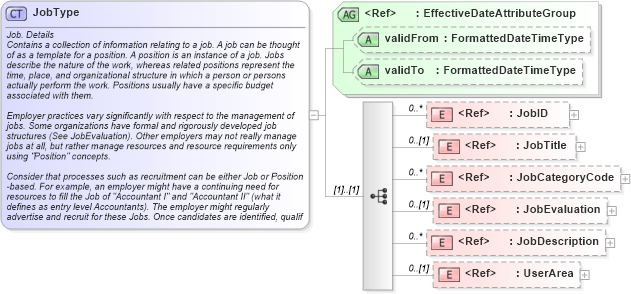
Drilldown into UserArea in schema fields_xsd Drilldown into JobDescription in schema fields_xsd Drilldown into JobEvaluation in schema components_xsd Drilldown into JobCategoryCode in schema fields_xsd Drilldown into JobTitle in schema fields_xsd1 Drilldown into JobID in schema fields_xsd Drilldown into validTo in schema fields_xsd Drilldown into validFrom in schema fields_xsd Drilldown into EffectiveDateAttributeGroup in schema fields_xsdXSD Diagram of JobType in schema components_xsd (HR-XML - Human Resources XML)
Collapse XSD Schema Code:
<xsd:complexType name="JobType">
    <xsd:annotation>
        <xsd:documentation source="http://www.hr-xml.org" xml:lang="en">
            <ccts:DictionaryEntryName xmlns:ccts="urn:un:unece:uncefact:documentation:1.1">Job. Details</ccts:DictionaryEntryName>
            <ccts:DefinitionText xmlns:ccts="urn:un:unece:uncefact:documentation:1.1">Contains a collection of information relating to a job. A job can be thought of as a template for a position. A position is an instance of a job. Jobs describe the nature of the work, whereas related positions represent the time, place, and organizational structure in which a person or persons actually perform the work. Positions usually have a specific budget associated with them. 			
				</ccts:DefinitionText>
            <ccts:UsageRule xmlns:ccts="urn:un:unece:uncefact:documentation:1.1">Employer practices vary significantly with respect to the management of jobs. Some organizations have formal and rigorously developed job structures (See JobEvaluation). Other employers may not really manage jobs at all, but rather manage resources and resource requirements only using "Position" concepts. 
								
				Consider that processes such as recruitment can be either Job or Position-based. For example, an employer might have a continuing need for resources to fill the Job of "Accountant I" and "Accountant II" (what it defines as entry level Accountants). The employer might regularly advertise and recruit for these Jobs. Once candidates are identified, qualified ones might be associated and considered with respect to specific positions (For example, an Account I position specializing in Banking at the London office).
				
				Broadly speaking, the HR-XML library is designed to flexibly accomodate Job and Position-based processes. Both JobDetails and Position components (or qualified versions of these components) usually are presented as options within the same context. Where used, both are optional so implementers can choose to use or not use one or both of these components as their situation dictates.				
				</ccts:UsageRule>
        </xsd:documentation>
    </xsd:annotation>
    <xsd:sequence>
        <xsd:element ref="JobID" minOccurs="0" maxOccurs="unbounded" />
        <xsd:element ref="oa:JobTitle" minOccurs="0" />
        <xsd:element ref="JobCategoryCode" minOccurs="0" maxOccurs="unbounded" />
        <xsd:element ref="JobEvaluation" minOccurs="0" />
        <xsd:element ref="JobDescription" minOccurs="0" maxOccurs="unbounded" />
        <xsd:element ref="UserArea" minOccurs="0" />
    </xsd:sequence>
    <xsd:attributeGroup ref="EffectiveDateAttributeGroup" />
</xsd:complexType>
Collapse Child Elements:
Name Type Min Occurs Max Occurs
JobID nsA:JobID 0 unbounded
JobTitle oa:JobTitle 0 (1)
JobCategoryCode nsA:JobCategoryCode 0 unbounded
JobEvaluation nsA:JobEvaluation 0 (1)
JobDescription nsA:JobDescription 0 unbounded
UserArea nsA:UserArea 0 (1)
Collapse Child Attributes:
Name Type Default Value Use
validFrom nsA:validFrom Optional
validTo nsA:validTo Optional
Collapse Derivation Tree:
Collapse References:
nsA:Job