Definition Type: ComplexType
Name: Interval
Namespace: http://www.fpml.org/2007/FpML-4-4
Containing Schema: fpml-shared-4-4.xsd
Abstract
Documentation:
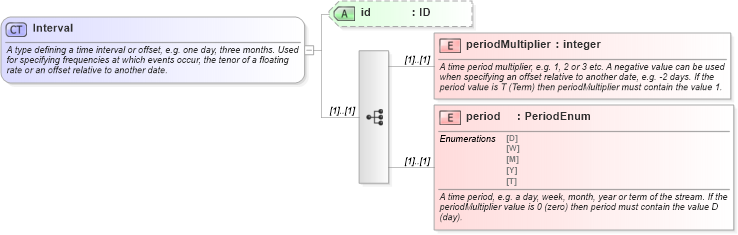
A type defining a time interval or offset, e.g. one day, three months. Used for specifying frequencies at which events occur, the tenor of a floating rate or an offset relative to another date.
Collapse XSD Schema Diagram:
Drilldown into period in schema fpml-shared-4-4_xsd Drilldown into periodMultiplier in schema fpml-shared-4-4_xsd Drilldown into id in schema fpml-shared-4-4_xsdXSD Diagram of Interval in schema fpml-shared-4-4_xsd (Financial products Markup Language (FpML®))
Collapse XSD Schema Code:
<xsd:complexType name="Interval">
    <xsd:annotation>
        <xsd:documentation xml:lang="en">A type defining a time interval or offset, e.g. one day, three months. Used for specifying frequencies at which events occur, the tenor of a floating rate or an offset relative to another date.</xsd:documentation>
    </xsd:annotation>
    <xsd:sequence>
        <xsd:element name="periodMultiplier" type="xsd:integer">
            <xsd:annotation>
                <xsd:documentation xml:lang="en">A time period multiplier, e.g. 1, 2 or 3 etc. A negative value can be used when specifying an offset relative to another date, e.g. -2 days. If the period value is T (Term) then periodMultiplier must contain the value 1.</xsd:documentation>
            </xsd:annotation>
        </xsd:element>
        <xsd:element name="period" type="PeriodEnum">
            <xsd:annotation>
                <xsd:documentation xml:lang="en">A time period, e.g. a day, week, month, year or term of the stream. If the periodMultiplier value is 0 (zero) then period must contain the value D (day).</xsd:documentation>
            </xsd:annotation>
        </xsd:element>
    </xsd:sequence>
    <xsd:attribute name="id" type="xsd:ID" />
</xsd:complexType>
Collapse Child Elements:
Name Type Min Occurs Max Occurs
periodMultiplier fpml:periodMultiplier (1) (1)
period fpml:period (1) (1)
Collapse Child Attributes:
Name Type Default Value Use
id fpml:id (Optional)
Collapse Derivation Tree:
Collapse References:
fpml:CalculationPeriodFrequency, fpml:earliestExerciseDateTenor, fpml:endTerm, fpml:exerciseFrequency, fpml:indexTenor, fpml:indexTenor, fpml:indexTenorfpml:interestPaymentTenor, fpml:mandatoryEarlyTerminationDateTenor, fpml:maximumMaturity, fpml:Offset, fpml:paymentFrequency, fpml:paymentFrequency, fpml:paymentFrequency, fpml:paymentFrequency, fpml:paymentFrequency, fpml:paymentFrequency, fpml:paymentFrequency, fpml:paymentFrequency, fpml:quotedTenor, fpml:relativeDate, fpml:ResetFrequency, fpml:startTerm, fpml:stepFrequency, fpml:tenor, fpml:tenor, fpml:tenor, fpml:term, fpml:term, fpml:term, fpml:term,