Definition Type: ComplexType
Name: EscapeRegexFunctionType
Namespace: http://oval.mitre.org/XMLSchema/oval-definitions-5
Containing Schema: oval-definitions-schema.xsd
Abstract
Documentation:
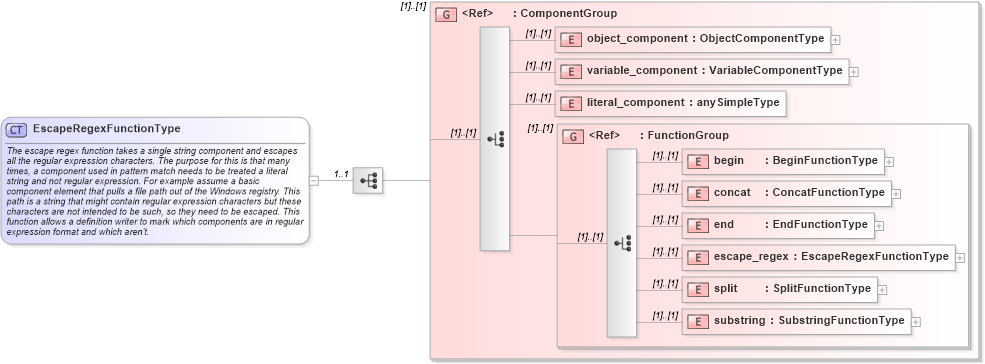
The escape regex function takes a single string component and escapes all the regular expression characters. The purpose for this is that many times, a component used in pattern match needs to be treated a literal string and not regular expression. For example assume a basic component element that pulls a file path out of the Windows registry. This path is a string that might contain regular expression characters but these characters are not intended to be such, so they need to be escaped. This function allows a definition writer to mark which components are in regular expression format and which aren't.
Collapse XSD Schema Diagram:
Drilldown into substring in schema oval-definitions-schema_xsd Drilldown into split in schema oval-definitions-schema_xsd Drilldown into escape_regex in schema oval-definitions-schema_xsd Drilldown into end in schema oval-definitions-schema_xsd Drilldown into concat in schema oval-definitions-schema_xsd Drilldown into begin in schema oval-definitions-schema_xsd Drilldown into FunctionGroup in schema oval-definitions-schema_xsd Drilldown into literal_component in schema oval-definitions-schema_xsd Drilldown into variable_component in schema oval-definitions-schema_xsd Drilldown into object_component in schema oval-definitions-schema_xsd Drilldown into ComponentGroup in schema oval-definitions-schema_xsdXSD Diagram of EscapeRegexFunctionType in schema oval-definitions-schema_xsd (Open Vulnerability and Assessment Language (OVAL®))
Collapse XSD Schema Code:
<xsd:complexType name="EscapeRegexFunctionType">
    <xsd:annotation>
        <xsd:documentation>The escape regex function takes a single string component and escapes all the regular expression characters. The purpose for this is that many times, a component used in pattern match needs to be treated a literal string and not regular expression. For example assume a basic component element that pulls a file path out of the Windows registry. This path is a string that might contain regular expression characters but these characters are not intended to be such, so they need to be escaped. This function allows a definition writer to mark which components are in regular expression format and which aren't.</xsd:documentation>
    </xsd:annotation>
    <xsd:sequence minOccurs="1" maxOccurs="1">
        <xsd:group ref="oval-def:ComponentGroup" />
    </xsd:sequence>
</xsd:complexType>
Collapse Child Elements:
Name Type Min Occurs Max Occurs
object_component oval-def:object_component (1) (1)
variable_component oval-def:variable_component (1) (1)
literal_component oval-def:literal_component (1) (1)
begin oval-def:begin (1) (1)
concat oval-def:concat (1) (1)
end oval-def:end (1) (1)
escape_regex oval-def:escape_regex (1) (1)
split oval-def:split (1) (1)
substring oval-def:substring (1) (1)
<xs:group> oval-def:ComponentGroup (1) (1)
<xs:group> oval-def:FunctionGroup (1) (1)
Collapse Derivation Tree:
Collapse References:
oval-def:escape_regex