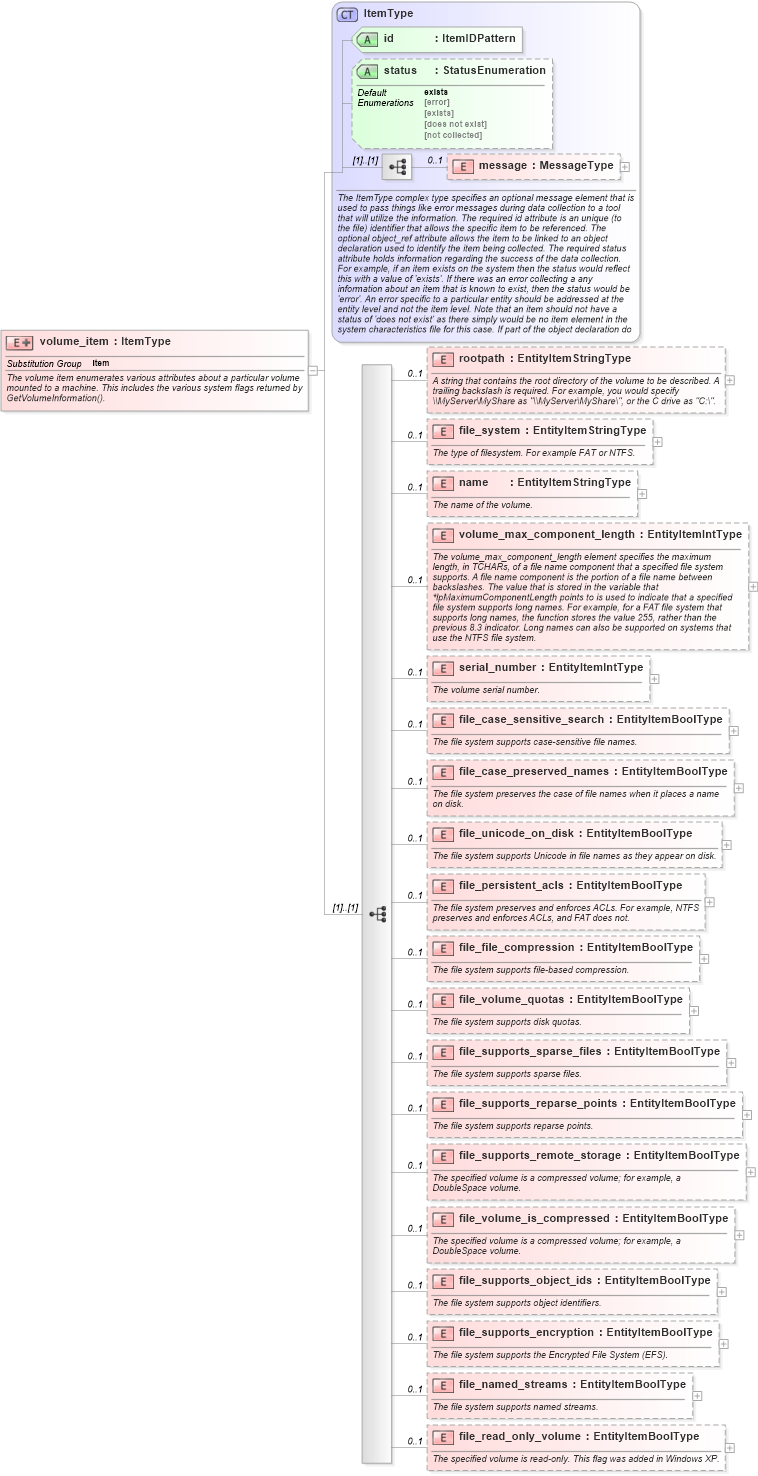
<xsd:element name="volume_item" substitutionGroup="oval-sc:item">
<xsd:annotation>
<xsd:documentation>The volume item enumerates various attributes about a particular volume mounted to a machine. This includes the various system flags returned by GetVolumeInformation().</xsd:documentation>
</xsd:annotation>
<xsd:complexType>
<xsd:complexContent>
<xsd:extension base="oval-sc:ItemType">
<xsd:sequence>
<xsd:element name="rootpath" type="oval-sc:EntityItemStringType" minOccurs="0" maxOccurs="1">
<xsd:annotation>
<xsd:documentation>A string that contains the root directory of the volume to be described. A trailing backslash is required. For example, you would specify \\MyServer\MyShare as "\\MyServer\MyShare\", or the C drive as "C:\".</xsd:documentation>
<xsd:appinfo>
<sch:pattern id="volitemrootpath" xmlns:sch="http://purl.oclc.org/dsdl/schematron">
<sch:rule context="win-sc:volume_item/win-sc:rootpath">
<sch:assert test="not(@datatype) or @datatype='string'">item <sch:value-of select="../@id" /> - datatype attribute for the rootpath entity of a volume_item should be 'string'</sch:assert>
</sch:rule>
</sch:pattern>
</xsd:appinfo>
</xsd:annotation>
</xsd:element>
<xsd:element name="file_system" type="oval-sc:EntityItemStringType" minOccurs="0" maxOccurs="1">
<xsd:annotation>
<xsd:documentation>The type of filesystem. For example FAT or NTFS.</xsd:documentation>
<xsd:appinfo>
<sch:pattern id="volitemfile_system" xmlns:sch="http://purl.oclc.org/dsdl/schematron">
<sch:rule context="win-sc:volume_item/win-sc:file_system">
<sch:assert test="not(@datatype) or @datatype='string'">item <sch:value-of select="../@id" /> - datatype attribute for the file_system entity of a volume_item should be 'string'</sch:assert>
</sch:rule>
</sch:pattern>
</xsd:appinfo>
</xsd:annotation>
</xsd:element>
<xsd:element name="name" type="oval-sc:EntityItemStringType" minOccurs="0" maxOccurs="1">
<xsd:annotation>
<xsd:documentation>The name of the volume.</xsd:documentation>
<xsd:appinfo>
<sch:pattern id="volitemname" xmlns:sch="http://purl.oclc.org/dsdl/schematron">
<sch:rule context="win-sc:volume_item/win-sc:name">
<sch:assert test="not(@datatype) or @datatype='string'">item <sch:value-of select="../@id" /> - datatype attribute for the name entity of a volume_item should be 'string'</sch:assert>
</sch:rule>
</sch:pattern>
</xsd:appinfo>
</xsd:annotation>
</xsd:element>
<xsd:element name="volume_max_component_length" type="oval-sc:EntityItemIntType" minOccurs="0" maxOccurs="1">
<xsd:annotation>
<xsd:documentation>The volume_max_component_length element specifies the maximum length, in TCHARs, of a file name component that a specified file system supports. A file name component is the portion of a file name between backslashes. The value that is stored in the variable that *lpMaximumComponentLength points to is used to indicate that a specified file system supports long names. For example, for a FAT file system that supports long names, the function stores the value 255, rather than the previous 8.3 indicator. Long names can also be supported on systems that use the NTFS file system.</xsd:documentation>
<xsd:appinfo>
<sch:pattern id="volitemvolume_max_component_length" xmlns:sch="http://purl.oclc.org/dsdl/schematron">
<sch:rule context="win-sc:volume_item/win-sc:volume_max_component_length">
<sch:assert test="@datatype='int'">item <sch:value-of select="../@id" /> - datatype attribute for the volume_max_component_length entity of a volume_item should be 'int'</sch:assert>
</sch:rule>
</sch:pattern>
</xsd:appinfo>
</xsd:annotation>
</xsd:element>
<xsd:element name="serial_number" type="oval-sc:EntityItemIntType" minOccurs="0" maxOccurs="1">
<xsd:annotation>
<xsd:documentation>The volume serial number.</xsd:documentation>
<xsd:appinfo>
<sch:pattern id="volitemserial_number" xmlns:sch="http://purl.oclc.org/dsdl/schematron">
<sch:rule context="win-sc:volume_item/win-sc:serial_number">
<sch:assert test="@datatype='int'">item <sch:value-of select="../@id" /> - datatype attribute for the serial_number entity of a volume_item should be 'int'</sch:assert>
</sch:rule>
</sch:pattern>
</xsd:appinfo>
</xsd:annotation>
</xsd:element>
<xsd:element name="file_case_sensitive_search" type="oval-sc:EntityItemBoolType" minOccurs="0" maxOccurs="1">
<xsd:annotation>
<xsd:documentation>The file system supports case-sensitive file names.</xsd:documentation>
<xsd:appinfo>
<sch:pattern id="volitemfile_case_sensitive_search" xmlns:sch="http://purl.oclc.org/dsdl/schematron">
<sch:rule context="win-sc:volume_item/win-sc:file_case_sensitive_search">
<sch:assert test="@datatype='boolean'">item <sch:value-of select="../@id" /> - datatype attribute for the file_case_sensitive_search entity of a volume_item should be 'boolean'</sch:assert>
</sch:rule>
</sch:pattern>
</xsd:appinfo>
</xsd:annotation>
</xsd:element>
<xsd:element name="file_case_preserved_names" type="oval-sc:EntityItemBoolType" minOccurs="0" maxOccurs="1">
<xsd:annotation>
<xsd:documentation>The file system preserves the case of file names when it places a name on disk.</xsd:documentation>
<xsd:appinfo>
<sch:pattern id="volitemfile_case_preserved_names" xmlns:sch="http://purl.oclc.org/dsdl/schematron">
<sch:rule context="win-sc:volume_item/win-sc:file_case_preserved_names">
<sch:assert test="@datatype='boolean'">item <sch:value-of select="../@id" /> - datatype attribute for the file_case_preserved_names entity of a volume_item should be 'boolean'</sch:assert>
</sch:rule>
</sch:pattern>
</xsd:appinfo>
</xsd:annotation>
</xsd:element>
<xsd:element name="file_unicode_on_disk" type="oval-sc:EntityItemBoolType" minOccurs="0" maxOccurs="1">
<xsd:annotation>
<xsd:documentation>The file system supports Unicode in file names as they appear on disk.</xsd:documentation>
<xsd:appinfo>
<sch:pattern id="volitemfile_unicode_on_disk" xmlns:sch="http://purl.oclc.org/dsdl/schematron">
<sch:rule context="win-sc:volume_item/win-sc:file_unicode_on_disk">
<sch:assert test="@datatype='boolean'">item <sch:value-of select="../@id" /> - datatype attribute for the file_unicode_on_disk entity of a volume_item should be 'boolean'</sch:assert>
</sch:rule>
</sch:pattern>
</xsd:appinfo>
</xsd:annotation>
</xsd:element>
<xsd:element name="file_persistent_acls" type="oval-sc:EntityItemBoolType" minOccurs="0" maxOccurs="1">
<xsd:annotation>
<xsd:documentation>The file system preserves and enforces ACLs. For example, NTFS preserves and enforces ACLs, and FAT does not.</xsd:documentation>
<xsd:appinfo>
<sch:pattern id="volitemfile_persistent_acls" xmlns:sch="http://purl.oclc.org/dsdl/schematron">
<sch:rule context="win-sc:volume_item/win-sc:file_persistent_acls">
<sch:assert test="@datatype='boolean'">item <sch:value-of select="../@id" /> - datatype attribute for the file_persistent_acls entity of a volume_item should be 'boolean'</sch:assert>
</sch:rule>
</sch:pattern>
</xsd:appinfo>
</xsd:annotation>
</xsd:element>
<xsd:element name="file_file_compression" type="oval-sc:EntityItemBoolType" minOccurs="0" maxOccurs="1">
<xsd:annotation>
<xsd:documentation>The file system supports file-based compression.</xsd:documentation>
<xsd:appinfo>
<sch:pattern id="volitemfile_file_compression" xmlns:sch="http://purl.oclc.org/dsdl/schematron">
<sch:rule context="win-sc:volume_item/win-sc:file_file_compression">
<sch:assert test="@datatype='boolean'">item <sch:value-of select="../@id" /> - datatype attribute for the file_file_compression entity of a volume_item should be 'boolean'</sch:assert>
</sch:rule>
</sch:pattern>
</xsd:appinfo>
</xsd:annotation>
</xsd:element>
<xsd:element name="file_volume_quotas" type="oval-sc:EntityItemBoolType" minOccurs="0" maxOccurs="1">
<xsd:annotation>
<xsd:documentation>The file system supports disk quotas.</xsd:documentation>
<xsd:appinfo>
<sch:pattern id="volitemfile_volume_quotas" xmlns:sch="http://purl.oclc.org/dsdl/schematron">
<sch:rule context="win-sc:volume_item/win-sc:file_volume_quotas">
<sch:assert test="@datatype='boolean'">item <sch:value-of select="../@id" /> - datatype attribute for the file_volume_quotas entity of a volume_item should be 'boolean'</sch:assert>
</sch:rule>
</sch:pattern>
</xsd:appinfo>
</xsd:annotation>
</xsd:element>
<xsd:element name="file_supports_sparse_files" type="oval-sc:EntityItemBoolType" minOccurs="0" maxOccurs="1">
<xsd:annotation>
<xsd:documentation>The file system supports sparse files.</xsd:documentation>
<xsd:appinfo>
<sch:pattern id="volitemfile_supports_sparse_files" xmlns:sch="http://purl.oclc.org/dsdl/schematron">
<sch:rule context="win-sc:volume_item/win-sc:file_supports_sparse_files">
<sch:assert test="@datatype='boolean'">item <sch:value-of select="../@id" /> - datatype attribute for the file_supports_sparse_files entity of a volume_item should be 'boolean'</sch:assert>
</sch:rule>
</sch:pattern>
</xsd:appinfo>
</xsd:annotation>
</xsd:element>
<xsd:element name="file_supports_reparse_points" type="oval-sc:EntityItemBoolType" minOccurs="0" maxOccurs="1">
<xsd:annotation>
<xsd:documentation>The file system supports reparse points.</xsd:documentation>
<xsd:appinfo>
<sch:pattern id="volitemfile_supports_reparse_points" xmlns:sch="http://purl.oclc.org/dsdl/schematron">
<sch:rule context="win-sc:volume_item/win-sc:file_supports_reparse_points">
<sch:assert test="@datatype='boolean'">item <sch:value-of select="../@id" /> - datatype attribute for the file_supports_reparse_points entity of a volume_item should be 'boolean'</sch:assert>
</sch:rule>
</sch:pattern>
</xsd:appinfo>
</xsd:annotation>
</xsd:element>
<xsd:element name="file_supports_remote_storage" type="oval-sc:EntityItemBoolType" minOccurs="0" maxOccurs="1">
<xsd:annotation>
<xsd:documentation>The specified volume is a compressed volume; for example, a DoubleSpace volume.</xsd:documentation>
<xsd:appinfo>
<sch:pattern id="volitemfile_supports_remote_storage" xmlns:sch="http://purl.oclc.org/dsdl/schematron">
<sch:rule context="win-sc:volume_item/win-sc:file_supports_remote_storage">
<sch:assert test="@datatype='boolean'">item <sch:value-of select="../@id" /> - datatype attribute for the file_supports_remote_storage entity of a volume_item should be 'boolean'</sch:assert>
</sch:rule>
</sch:pattern>
</xsd:appinfo>
</xsd:annotation>
</xsd:element>
<xsd:element name="file_volume_is_compressed" type="oval-sc:EntityItemBoolType" minOccurs="0" maxOccurs="1">
<xsd:annotation>
<xsd:documentation>The specified volume is a compressed volume; for example, a DoubleSpace volume.</xsd:documentation>
<xsd:appinfo>
<sch:pattern id="volitemfile_volume_is_compressed" xmlns:sch="http://purl.oclc.org/dsdl/schematron">
<sch:rule context="win-sc:volume_item/win-sc:file_volume_is_compressed">
<sch:assert test="@datatype='boolean'">item <sch:value-of select="../@id" /> - datatype attribute for the file_volume_is_compressed entity of a volume_item should be 'boolean'</sch:assert>
</sch:rule>
</sch:pattern>
</xsd:appinfo>
</xsd:annotation>
</xsd:element>
<xsd:element name="file_supports_object_ids" type="oval-sc:EntityItemBoolType" minOccurs="0" maxOccurs="1">
<xsd:annotation>
<xsd:documentation>The file system supports object identifiers.</xsd:documentation>
<xsd:appinfo>
<sch:pattern id="volitemfile_supports_object_ids" xmlns:sch="http://purl.oclc.org/dsdl/schematron">
<sch:rule context="win-sc:volume_item/win-sc:file_supports_object_ids">
<sch:assert test="@datatype='boolean'">item <sch:value-of select="../@id" /> - datatype attribute for the file_supports_object_ids entity of a volume_item should be 'boolean'</sch:assert>
</sch:rule>
</sch:pattern>
</xsd:appinfo>
</xsd:annotation>
</xsd:element>
<xsd:element name="file_supports_encryption" type="oval-sc:EntityItemBoolType" minOccurs="0" maxOccurs="1">
<xsd:annotation>
<xsd:documentation>The file system supports the Encrypted File System (EFS).</xsd:documentation>
<xsd:appinfo>
<sch:pattern id="volitemfile_supports_encryption" xmlns:sch="http://purl.oclc.org/dsdl/schematron">
<sch:rule context="win-sc:volume_item/win-sc:file_supports_encryption">
<sch:assert test="@datatype='boolean'">item <sch:value-of select="../@id" /> - datatype attribute for the file_supports_encryption entity of a volume_item should be 'boolean'</sch:assert>
</sch:rule>
</sch:pattern>
</xsd:appinfo>
</xsd:annotation>
</xsd:element>
<xsd:element name="file_named_streams" type="oval-sc:EntityItemBoolType" minOccurs="0" maxOccurs="1">
<xsd:annotation>
<xsd:documentation>The file system supports named streams.</xsd:documentation>
<xsd:appinfo>
<sch:pattern id="volitemfile_named_streams" xmlns:sch="http://purl.oclc.org/dsdl/schematron">
<sch:rule context="win-sc:volume_item/win-sc:file_named_streams">
<sch:assert test="@datatype='boolean'">item <sch:value-of select="../@id" /> - datatype attribute for the file_named_streams entity of a volume_item should be 'boolean'</sch:assert>
</sch:rule>
</sch:pattern>
</xsd:appinfo>
</xsd:annotation>
</xsd:element>
<xsd:element name="file_read_only_volume" type="oval-sc:EntityItemBoolType" minOccurs="0" maxOccurs="1">
<xsd:annotation>
<xsd:documentation>The specified volume is read-only. This flag was added in Windows XP.</xsd:documentation>
<xsd:appinfo>
<sch:pattern id="volitemfile_read_only_volume" xmlns:sch="http://purl.oclc.org/dsdl/schematron">
<sch:rule context="win-sc:volume_item/win-sc:file_read_only_volume">
<sch:assert test="@datatype='boolean'">item <sch:value-of select="../@id" /> - datatype attribute for the file_read_only_volume entity of a volume_item should be 'boolean'</sch:assert>
</sch:rule>
</sch:pattern>
</xsd:appinfo>
</xsd:annotation>
</xsd:element>
</xsd:sequence>
</xsd:extension>
</xsd:complexContent>
</xsd:complexType>
</xsd:element>
|
 XSD Schema Diagram: