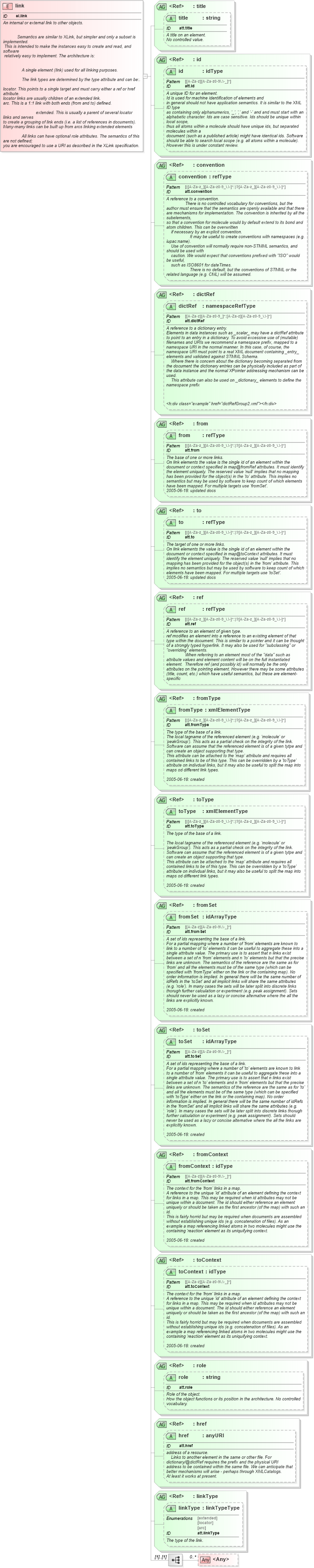
<xsd:element name="link" id="el.link">
    <xsd:annotation>
        <xsd:documentation>
            <h:div class="summary" xmlns:h="http://www.w3.org/1999/xhtml">An internal or external link to other objects.</h:div>
            <h:div class="description" xmlns:h="http://www.w3.org/1999/xhtml">
                <h:p>
                    <h:b>Semantics are similar to XLink, but simpler and only a subset is implemented.</h:b>
         This is intended to make the instances easy to create and read, and software
         relatively easy to implement. The architecture is:</h:p>
                <h:ul>
                    <h:li>
                        <h:b>A single element (<h:tt>link</h:tt>) used for all linking purposes.</h:b>
                    </h:li>
                    <h:li>
                        <h:b>The link types are determined by the <h:tt>type</h:tt> attribute and can be:</h:b>.
        <h:ul><h:li><h:b>locator</h:b>. This points to a single target and must carry either a <h:tt>ref</h:tt> or <h:tt>href</h:tt> attribute.
        <h:tt>locator</h:tt> links are usually children of an extended link.
        <h:li><h:b>arc</h:b>. This is a 1:1 link with both ends (<h:tt>from</h:tt> and <h:tt>to</h:tt>) defined.</h:li>
                                <h:li>
                                    <h:b>extended</h:b>. This is usually a parent of several locator links and serves
        to create a grouping of link ends (i.e. a list of references in documents).</h:li>
        Many-many links can be built up from arcs linking extended elements</h:li>
                        </h:ul>
                        <h:p>All links can have optional <h:tt>role</h:tt> attributes. The semantics of this are not defined;
        you are encouraged to use a URI as described in the XLink specification.</h:p>
                        <h:p>There are two address spaces: </h:p>
                        <h:ul>
                            <h:li>The <h:tt>href</h:tt> attribute on locators behaves in the same way as <h:tt>href</h:tt> in
        HTML and is of type <h:tt>xsd:anyURI</h:tt>. Its primary use is to use XPointer to reference
        elements outside the document.</h:li>
                            <h:li>The <h:tt>ref</h:tt> attribute on locators and the <h:tt>from</h:tt> and <h:tt>to</h:tt>
        attributes on <h:tt>arc</h:tt>s refer to IDs (<h:em>without</h:em> the '#' syntax).</h:li>
                        </h:ul>
                        <h:p>Note: several other specific linking mechanisms are defined elsewhere in STM. <h:a href="el.relatedEntry">relatedEntry</h:a> should be used in dictionaries, and <h:a href="st.dictRef">dictRef</h:a>
        should be used to link to dictionaries. There are no required uses of <h:tt>link</h:tt> in STMML
        but we have used it to map atoms, electrons and bonds in reactions in CML</h:p>
                    </h:li>
                </h:ul>
                <h:p>
                    <h:b>Relation to XLink</h:b>.
         At present (2002) we are not aware of generic XLink
         processors from which we would benefit, so the complete implementation brings little
         extra value.
         Among the simplifications from Xlink are:</h:p>
                <h:ul>
                    <h:li>
                        <h:tt>type</h:tt> supports only <h:tt>extended</h:tt>, <h:tt>locator</h:tt> and <h:tt>arc</h:tt>
                    </h:li>
                    <h:li>
                        <h:tt>label</h:tt> is not supported and <h:tt>id</h:tt>s are used as targets of links.</h:li>
                    <h:li>
                        <h:tt>show</h:tt> and <h:tt>actuate</h:tt> are not supported.</h:li>
                    <h:li>
                        <h:tt>xlink:title</h:tt> is not supported (all STM elements can have a <h:tt>title</h:tt>
         attribute).</h:li>
                    <h:li>
                        <h:tt>xlink:role</h:tt> supports any string (i.e. does not have to be a namespaced resource).
         This mechanism can, of course, still be used and we shall promote it where STM
         benefits from it</h:li>
                    <h:li>The <h:tt>to</h:tt> and <h:tt>from</h:tt> attributes point to IDs rather than labels</h:li>
                    <h:li>The xlink namespace is not used</h:li>
                    <h:li>It is not intended to create independent linkbases, although some collections of
         links may have this property and stand outside the documents they link to</h:li>
                </h:ul>
            </h:div>
        </xsd:documentation>
    </xsd:annotation>
    <xsd:complexType>
        <xsd:sequence>
            <xsd:any minOccurs="0" maxOccurs="unbounded" />
        </xsd:sequence>
        <xsd:attributeGroup ref="title" />
        <xsd:attributeGroup ref="id" />
        <xsd:attributeGroup ref="convention" />
        <xsd:attributeGroup ref="dictRef" />
        <xsd:attributeGroup ref="from" />
        <xsd:attributeGroup ref="to" />
        <xsd:attributeGroup ref="ref" />
        <xsd:attributeGroup ref="fromType">
            <xsd:annotation>
                <xsd:documentation>
                    <h:div class="specific" xmlns:h="http://www.w3.org/1999/xhtml">The type of the object/element in the 'from' attributes. Requires the objects referenced by the 'from' attributes to have a given elementType. Can be overridden by 'from' attributes in individual links. 2005-06-18: created</h:div>
                </xsd:documentation>
            </xsd:annotation>
        </xsd:attributeGroup>
        <xsd:attributeGroup ref="toType">
            <xsd:annotation>
                <xsd:documentation>
                    <h:div class="specific" xmlns:h="http://www.w3.org/1999/xhtml">The type of the object/element in the 'to' attributes. Requires the objects referenced by the 'to' attributes to have a given elementType. Can be overridden by 'to' attributes in individual links. 2005-06-18: created</h:div>
                </xsd:documentation>
            </xsd:annotation>
        </xsd:attributeGroup>
        <xsd:attributeGroup ref="fromSet">
            <xsd:annotation>
                <xsd:documentation>
                    <h:div class="specific" xmlns:h="http://www.w3.org/1999/xhtml">The set of ids in the base of the link. 2005-06-18: created</h:div>
                </xsd:documentation>
            </xsd:annotation>
        </xsd:attributeGroup>
        <xsd:attributeGroup ref="toSet">
            <xsd:annotation>
                <xsd:documentation>
                    <h:div class="specific" xmlns:h="http://www.w3.org/1999/xhtml">The set of ids in the target of the link. 2005-06-18: created</h:div>
                </xsd:documentation>
            </xsd:annotation>
        </xsd:attributeGroup>
        <xsd:attributeGroup ref="fromContext">
            <xsd:annotation>
                <xsd:documentation>
                    <h:div class="specific" xmlns:h="http://www.w3.org/1999/xhtml">The id of the ancestral element of objects referenced by 'from' attributes. Provides a context for uniquifying the references in the 'from' attributes. Thus atoms referenced by ids should be unique within a given molecule and the id of this could be the 'fromContext'. 2005-06-18: created</h:div>
                </xsd:documentation>
            </xsd:annotation>
        </xsd:attributeGroup>
        <xsd:attributeGroup ref="toContext">
            <xsd:annotation>
                <xsd:documentation>
                    <h:div class="specific" xmlns:h="http://www.w3.org/1999/xhtml">The id of the ancestral element of objects referenced by 'to' attributes. Provides a context for uniquifying the references in the 'to' attributes. Thus atoms referenced by ids should be unique within a given molecule and the id of this could be the 'toContext'. 2005-06-18: created</h:div>
                </xsd:documentation>
            </xsd:annotation>
        </xsd:attributeGroup>
        <xsd:attributeGroup ref="role">
            <xsd:annotation>
                <xsd:documentation>
                    <h:div class="specific" xmlns:h="http://www.w3.org/1999/xhtml">The role of the link. Xlink adds semantics through a
          URI; we shall not be this strict. We shall not normally use this mechanism
          and use dictionaries instead.</h:div>
                </xsd:documentation>
            </xsd:annotation>
        </xsd:attributeGroup>
        <xsd:attributeGroup ref="href">
            <xsd:annotation>
                <xsd:documentation>
                    <h:div class="specific" xmlns:h="http://www.w3.org/1999/xhtml">The target of the (locator) link, outside the document.</h:div>
                </xsd:documentation>
            </xsd:annotation>
        </xsd:attributeGroup>
        <xsd:attributeGroup ref="linkType" />
    </xsd:complexType>
</xsd:element>
|
 XSD Schema Diagram: