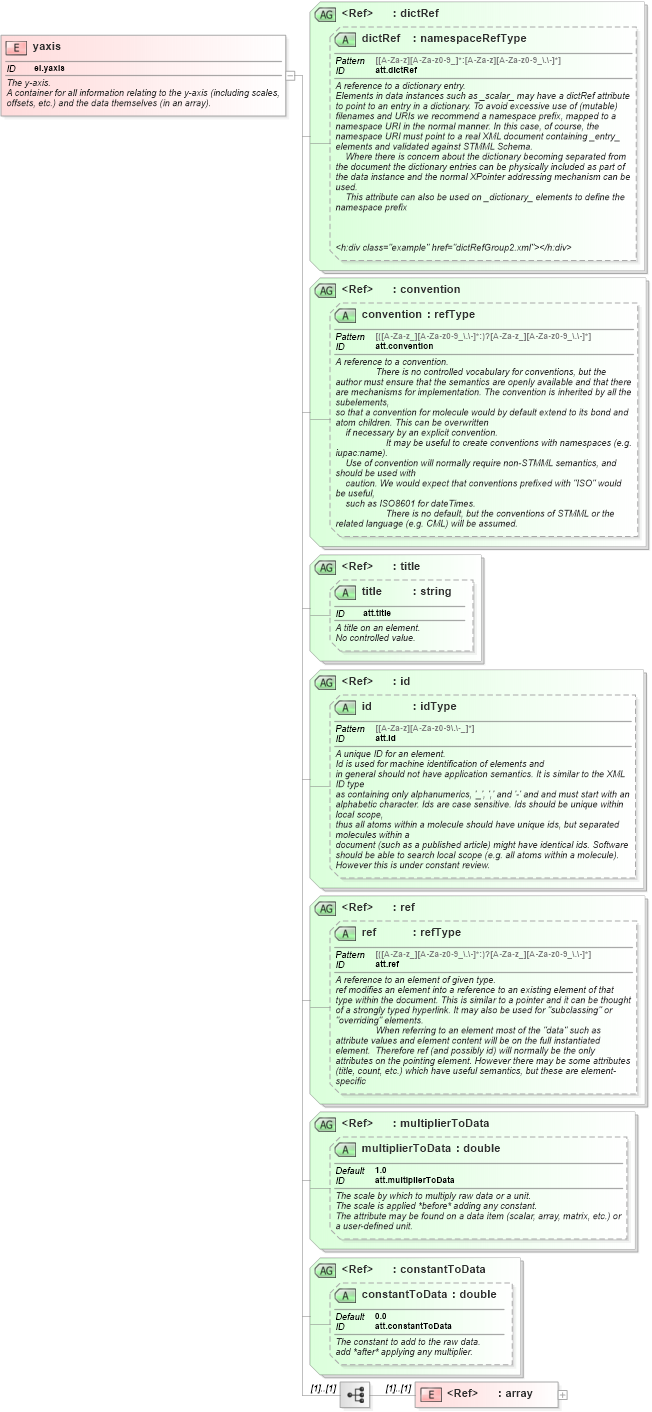
<xsd:element name="yaxis" id="el.yaxis">
    <xsd:annotation>
        <xsd:documentation>
            <h:div class="summary" xmlns:h="http://www.w3.org/1999/xhtml">The y-axis.</h:div>
            <h:div class="description" xmlns:h="http://www.w3.org/1999/xhtml">A container for all information relating to the y-axis (including scales, offsets, etc.) and the data themselves (in an <h:tt>array</h:tt>).</h:div>
            <h:div class="example" href="yaxis1.xml" xmlns:h="http://www.w3.org/1999/xhtml" />
        </xsd:documentation>
    </xsd:annotation>
    <xsd:complexType>
        <xsd:sequence>
            <xsd:element ref="array">
                <xsd:annotation>
                    <xsd:documentation>
                        <h:div xmlns:h="http://www.w3.org/1999/xhtml">The y-data. These must match the x-data in number and order. There are tools to allow scaling and transformation (though unscaled data must be very carefully defined).</h:div>
                    </xsd:documentation>
                </xsd:annotation>
            </xsd:element>
        </xsd:sequence>
        <xsd:attributeGroup ref="dictRef" />
        <xsd:attributeGroup ref="convention" />
        <xsd:attributeGroup ref="title" />
        <xsd:attributeGroup ref="id" />
        <xsd:attributeGroup ref="ref" />
        <xsd:attributeGroup ref="multiplierToData" />
        <xsd:attributeGroup ref="constantToData" />
    </xsd:complexType>
</xsd:element>
|
 XSD Schema Diagram: