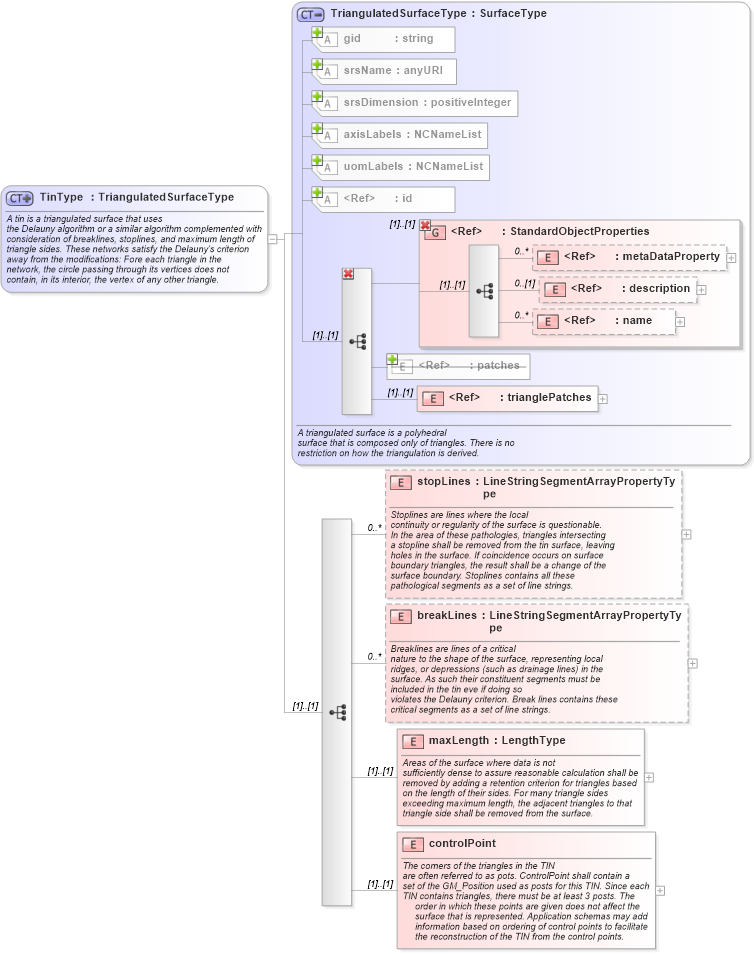
<complexType name="TinType">
    <annotation>
        <documentation>A tin is a triangulated surface that uses
   the Delauny algorithm or a similar algorithm complemented with
   consideration of breaklines, stoplines, and maximum length of
   triangle sides. These networks satisfy the Delauny's criterion
   away from the modifications: Fore each triangle in the
   network, the circle passing through its vertices does not
   contain, in its interior, the vertex of any other triangle.</documentation>
    </annotation>
    <complexContent>
        <extension base="gml:TriangulatedSurfaceType">
            <sequence>
                <element name="stopLines" type="gml:LineStringSegmentArrayPropertyType" minOccurs="0" maxOccurs="unbounded">
                    <annotation>
                        <documentation>Stoplines are lines where the local
       continuity or regularity of the surface is questionable.
       In the area of these pathologies, triangles intersecting
       a stopline shall be removed from the tin surface, leaving
       holes in the surface. If coincidence occurs on surface
       boundary triangles, the result shall be a change of the
       surface boundary. Stoplines contains all these
       pathological segments as a set of line strings.</documentation>
                    </annotation>
                </element>
                <element name="breakLines" type="gml:LineStringSegmentArrayPropertyType" minOccurs="0" maxOccurs="unbounded">
                    <annotation>
                        <documentation>Breaklines are lines of a critical
       nature to the shape of the surface, representing local
       ridges, or depressions (such as drainage lines) in the
       surface. As such their constituent segments must be
       included in the tin eve if doing so
       violates the Delauny criterion. Break lines contains these
       critical segments as a set of line strings.</documentation>
                    </annotation>
                </element>
                <element name="maxLength" type="gml:LengthType">
                    <annotation>
                        <documentation>Areas of the surface where data is not
       sufficiently dense to assure reasonable calculation shall be
       removed by adding a retention criterion for triangles based
       on the length of their sides. For many triangle sides
       exceeding maximum length, the adjacent triangles to that
       triangle side shall be removed from the surface.</documentation>
                    </annotation>
                </element>
                <element name="controlPoint">
                    <annotation>
                        <documentation>The corners of the triangles in the TIN
  are often referred to as pots. ControlPoint shall contain a
  set of the GM_Position used as posts for this TIN. Since each
  TIN contains triangles, there must be at least 3 posts. The
       order in which these points are given does not affect the
       surface that is represented. Application schemas may add
       information based on ordering of control points to facilitate
       the reconstruction of the TIN from the control points.</documentation>
                    </annotation>
                    <complexType>
                        <choice>
                            <element ref="gml:posList" />
                            <group ref="gml:geometricPositionGroup" minOccurs="3" maxOccurs="unbounded" />
                        </choice>
                    </complexType>
                </element>
            </sequence>
        </extension>
    </complexContent>
</complexType>
|
 XSD Schema Diagram: