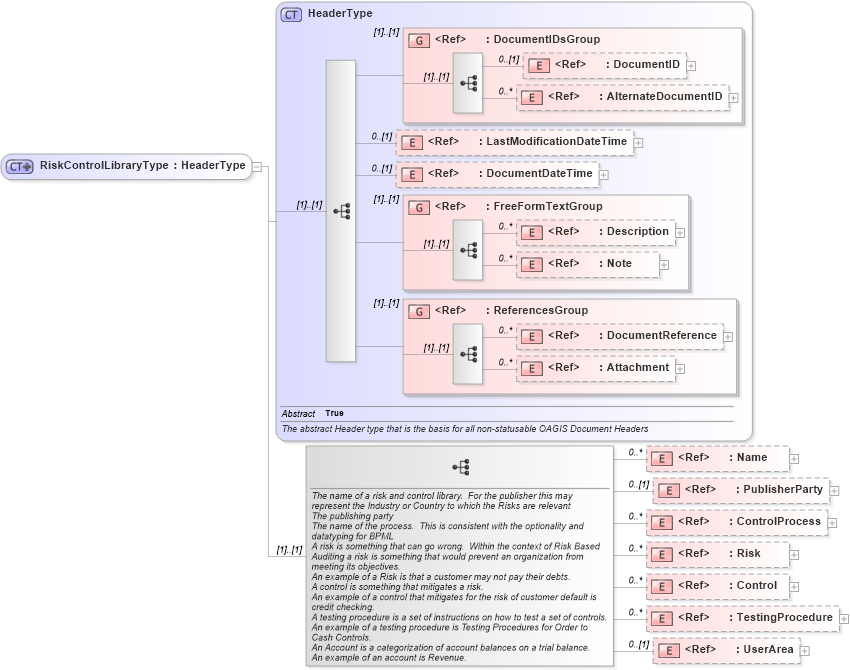
<xsd:complexType name="RiskControlLibraryType">
    <xsd:complexContent>
        <xsd:extension base="HeaderType">
            <xsd:sequence>
                <xsd:annotation>
                    <xsd:documentation>The name of a risk and control library.  For the publisher this may represent the Industry or Country to which the Risks are relevant</xsd:documentation>
                    <xsd:documentation>The publishing party</xsd:documentation>
                    <xsd:documentation>The name of the process.  This is consistent with the optionality and datatyping for BPML</xsd:documentation>
                    <xsd:documentation>A risk is something that can go wrong.  Within the context of Risk Based Auditing a risk is something that would prevent an organization from meeting its objectives.</xsd:documentation>
                    <xsd:documentation>An example of a Risk is that a customer may not pay their debts.</xsd:documentation>
                    <xsd:documentation>A control is something that mitigates a risk.</xsd:documentation>
                    <xsd:documentation>An example of a control that mitigates for the risk of customer default is credit checking.</xsd:documentation>
                    <xsd:documentation>A testing procedure is a set of instructions on how to test a set of controls.</xsd:documentation>
                    <xsd:documentation>An example of a testing procedure is Testing Procedures for Order to Cash Controls.</xsd:documentation>
                    <xsd:documentation>An Account is a categorization of account balances on a trial balance.</xsd:documentation>
                    <xsd:documentation>An example of an account is Revenue.</xsd:documentation>
                </xsd:annotation>
                <xsd:element ref="Name" minOccurs="0" maxOccurs="unbounded" />
                <xsd:element ref="PublisherParty" minOccurs="0" />
                <xsd:element ref="ControlProcess" minOccurs="0" maxOccurs="unbounded" />
                <xsd:element ref="Risk" minOccurs="0" maxOccurs="unbounded" />
                <xsd:element ref="Control" minOccurs="0" maxOccurs="unbounded" />
                <xsd:element ref="TestingProcedure" minOccurs="0" maxOccurs="unbounded" />
                <xsd:element ref="UserArea" minOccurs="0" />
            </xsd:sequence>
        </xsd:extension>
    </xsd:complexContent>
</xsd:complexType>
|
 XSD Schema Diagram: