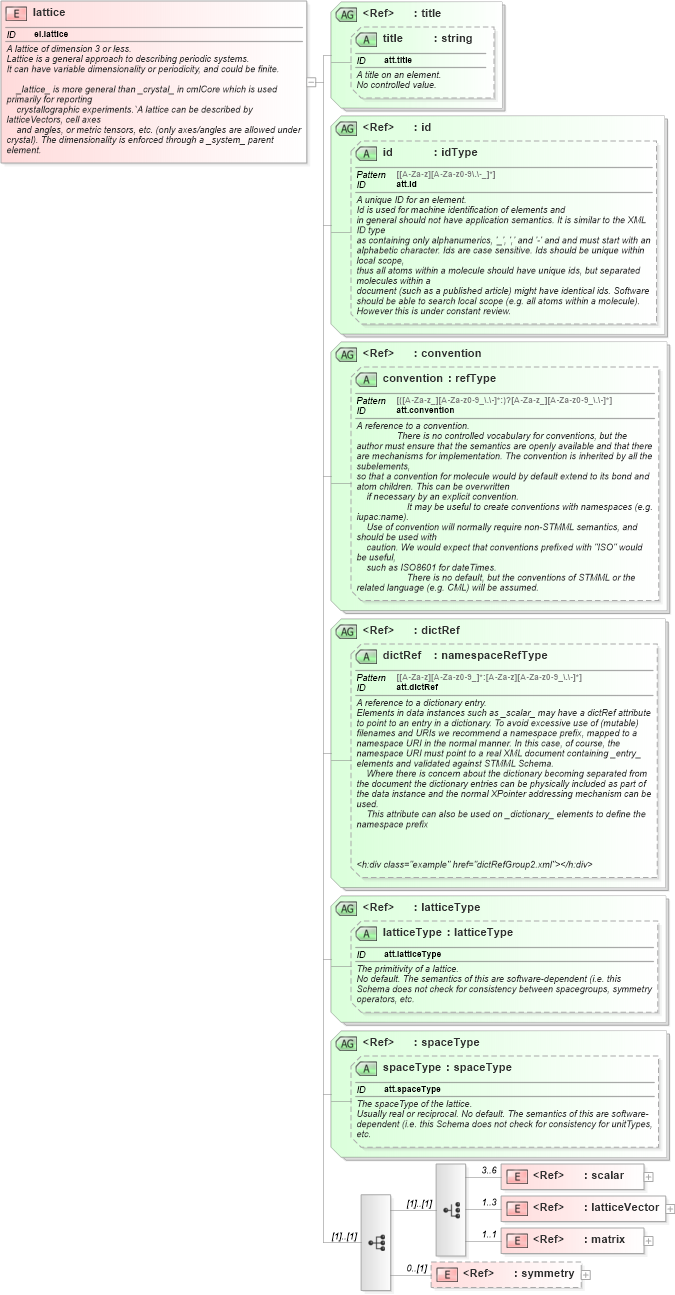
<xsd:element name="lattice" id="el.lattice">
    <xsd:annotation>
        <xsd:documentation>
            <h:div class="summary" xmlns:h="http://www.w3.org/1999/xhtml">A lattice of dimension 3 or less.</h:div>
            <h:div class="description" xmlns:h="http://www.w3.org/1999/xhtml">Lattice is a general approach to describing periodic systems.
            It can have variable dimensionality or periodicity, and could be finite.</h:div>
            <h:div class="note" xmlns:h="http://www.w3.org/1999/xhtml">
                _lattice_ is more general than _crystal_ in cmlCore which is used primarily for reporting
                crystallographic experiments.`A lattice can be described by latticeVectors, cell axes
                and angles, or metric tensors, etc. (only axes/angles are allowed under <h:tt>crystal</h:tt>). The dimensionality is enforced through a _system_ parent element.</h:div>
            <h:div class="example" href="lattice3.xml" xmlns:h="http://www.w3.org/1999/xhtml" />
        </xsd:documentation>
    </xsd:annotation>
    <xsd:complexType>
        <xsd:sequence>
            <xsd:choice>
                <xsd:element ref="scalar" minOccurs="3" maxOccurs="6">
                    <xsd:annotation>
                        <xsd:documentation>
                            <h:div class="summary" xmlns:h="http://www.w3.org/1999/xhtml">All appropriate cell parameters must be given, even
                            where angles are fixed by symmetry. The order is fixed as a,b,c,alpha,beta,gamma
                            and software can neglect any title or dictRef attributes. Error estimates
                            can be given if required. Any units can be used, but the defaults are
                            Angstrom (10^-10 m) and degrees. To be developed for lower dimensionality.</h:div>
                        </xsd:documentation>
                    </xsd:annotation>
                </xsd:element>
                <xsd:element ref="latticeVector" minOccurs="1" maxOccurs="3">
                    <!--
      <h:div class="summary">A number of lattice vectors equal to the dimensionality. Note that some vectors may give rise to periodicty while others do not. Thus a surface can be described by two vector in the plane of the surface and one perpendicular to them.</h:div>
-->
                </xsd:element>
                <xsd:element ref="matrix" minOccurs="1" maxOccurs="1">
                    <!--
      <h:div class="summary">The metric tensor (normally for 3 dimensions).</h:div>
-->
                </xsd:element>
            </xsd:choice>
            <xsd:element ref="symmetry" minOccurs="0" />
        </xsd:sequence>
        <xsd:attributeGroup ref="title" />
        <xsd:attributeGroup ref="id" />
        <xsd:attributeGroup ref="convention" />
        <xsd:attributeGroup ref="dictRef" />
        <xsd:attributeGroup ref="latticeType" />
        <xsd:attributeGroup ref="spaceType" />
    </xsd:complexType>
</xsd:element>
|
 XSD Schema Diagram: