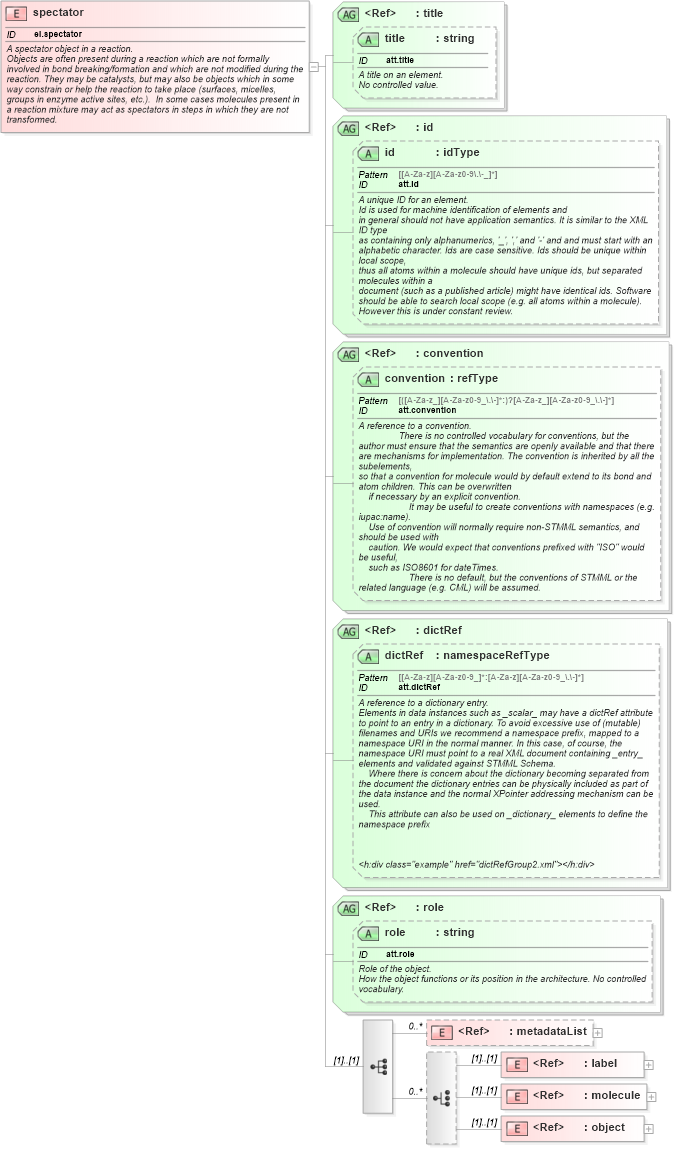
<xsd:element name="spectator" id="el.spectator">
    <xsd:annotation>
        <xsd:documentation>
            <h:div class="summary" xmlns:h="http://www.w3.org/1999/xhtml">A spectator object in a reaction.</h:div>
            <h:div class="description" xmlns:h="http://www.w3.org/1999/xhtml">Objects are often present during a reaction which are not formally involved in bond breaking/formation and which are not modified during the reaction. They may be catalysts, but may also be objects which in some way constrain or help the reaction to take place (surfaces, micelles, groups in enzyme active sites, etc.).  In some cases molecules present in a reaction mixture may act as spectators in steps in which they are not transformed.</h:div>
            <h:div class="example" href="spectator1.xml" xmlns:h="http://www.w3.org/1999/xhtml" />
        </xsd:documentation>
    </xsd:annotation>
    <xsd:complexType>
        <xsd:sequence>
            <xsd:element ref="metadataList" minOccurs="0" maxOccurs="unbounded" />
            <xsd:choice minOccurs="0" maxOccurs="unbounded">
                <xsd:element ref="label" />
                <xsd:element ref="molecule" />
                <xsd:element ref="object" />
            </xsd:choice>
        </xsd:sequence>
        <xsd:attributeGroup ref="title" />
        <xsd:attributeGroup ref="id" />
        <xsd:attributeGroup ref="convention" />
        <xsd:attributeGroup ref="dictRef" />
        <xsd:attributeGroup ref="role">
            <xsd:annotation>
                <xsd:documentation>
                    <h:div class="specific" xmlns:h="http://www.w3.org/1999/xhtml">No controlled vocabulary. Examples could be 'host', 'hydrophobic ligand', 'charge-stabilizer', etc..</h:div>
                </xsd:documentation>
            </xsd:annotation>
        </xsd:attributeGroup>
    </xsd:complexType>
</xsd:element>
|
 XSD Schema Diagram: