Definition Type: Element
Name: molecule
Namespace: http://www.xml-cml.org/schema
Containing Schema: schema.xsd
Abstract
Documentation:
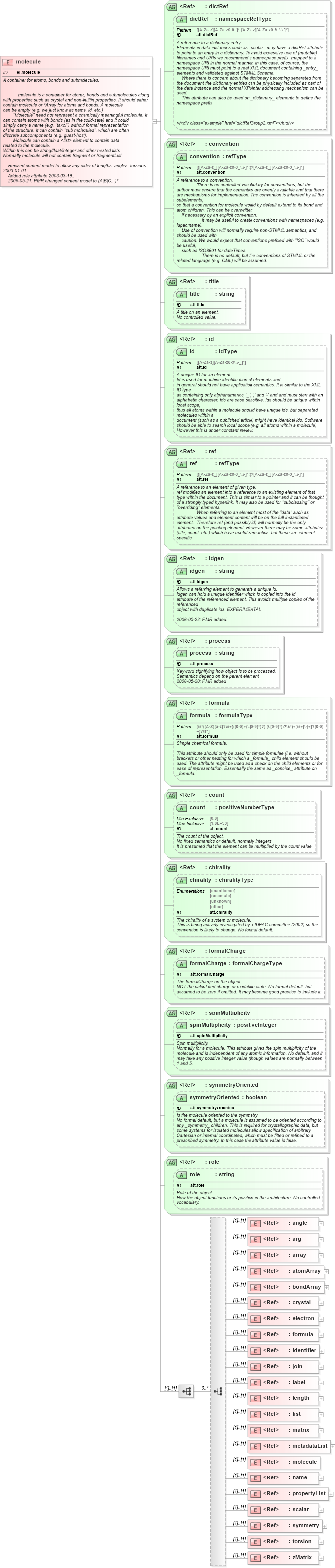
A container for atoms, bonds and submolecules. molecule is a container for atoms, bonds and submolecules along with properties such as crystal and non-builtin properties. It should either contain molecule or *Array for atoms and bonds. A molecule can be empty (e.g. we just know its name, id, etc.) "Molecule" need not represent a chemically meaningful molecule. It can contain atoms with bonds (as in the solid-sate) and it could simply carry a name (e.g. "taxol") without formal representation of the structure. It can contain "sub molecules", which are often discrete subcomponents (e.g. guest-host). Molecule can contain a <list> element to contain data related to the molecule. Within this can be string/float/integer and other nested lists Normally molecule will not contain fragment or fragmentList Revised content model to allow any order of lengths, angles, torsions 2003-01-01.. Added role attribute 2003-03-19.. 2006-05-21. PMR changed content model to (A|B|C...)* 2006-11-24. PMR removed @tail, @head, @countExpression, @repeat
Collapse XSD Schema Diagram:
Drilldown into zMatrix in schema schema_xsd Drilldown into torsion in schema schema_xsd Drilldown into symmetry in schema schema_xsd Drilldown into scalar in schema schema_xsd Drilldown into propertyList in schema schema_xsd Drilldown into name in schema schema_xsd Drilldown into molecule in schema schema_xsd Drilldown into metadataList in schema schema_xsd Drilldown into matrix in schema schema_xsd Drilldown into list in schema schema_xsd Drilldown into length in schema schema_xsd Drilldown into label in schema schema_xsd Drilldown into join in schema schema_xsd Drilldown into identifier in schema schema_xsd Drilldown into formula in schema schema_xsd Drilldown into electron in schema schema_xsd Drilldown into crystal in schema schema_xsd Drilldown into bondArray in schema schema_xsd Drilldown into atomArray in schema schema_xsd Drilldown into array in schema schema_xsd Drilldown into arg in schema schema_xsd Drilldown into angle in schema schema_xsd Drilldown into role in schema schema_xsd Drilldown into role in schema schema_xsd Drilldown into symmetryOriented in schema schema_xsd Drilldown into symmetryOriented in schema schema_xsd Drilldown into spinMultiplicity in schema schema_xsd Drilldown into spinMultiplicity in schema schema_xsd Drilldown into formalCharge in schema schema_xsd Drilldown into formalCharge in schema schema_xsd Drilldown into chirality in schema schema_xsd Drilldown into chirality in schema schema_xsd Drilldown into count in schema schema_xsd Drilldown into count in schema schema_xsd Drilldown into formula in schema schema_xsd Drilldown into formula in schema schema_xsd Drilldown into process in schema schema_xsd Drilldown into process in schema schema_xsd Drilldown into idgen in schema schema_xsd Drilldown into idgen in schema schema_xsd Drilldown into ref in schema schema_xsd Drilldown into ref in schema schema_xsd Drilldown into id in schema schema_xsd Drilldown into id in schema schema_xsd Drilldown into title in schema schema_xsd Drilldown into title in schema schema_xsd Drilldown into convention in schema schema_xsd Drilldown into convention in schema schema_xsd Drilldown into dictRef in schema schema_xsd Drilldown into dictRef in schema schema_xsdXSD Diagram of molecule in schema schema_xsd (Chemical Markup Language (CML))
Collapse XSD Schema Code:
<xsd:element name="molecule" id="el.molecule">
    <xsd:annotation>
        <xsd:documentation>
            <h:div class="summary" xmlns:h="http://www.w3.org/1999/xhtml">A container for atoms, bonds and submolecules.</h:div>
            <h:div class="description" xmlns:h="http://www.w3.org/1999/xhtml">
                <h:p>
                    <h:tt>molecule</h:tt> is a container for atoms, bonds and submolecules along
        with properties such as crystal and non-builtin properties. It should either
        contain <h:tt>molecule</h:tt> or *Array for atoms and bonds. A molecule
        can be empty (e.g. we just know its name, id, etc.)</h:p>
                <h:p>"Molecule" need not represent a chemically meaningful molecule. It
        can contain atoms with bonds (as in the solid-sate) and it could 
        simply carry a name (e.g. "taxol") without formal representation
        of the structure. It can contain "sub molecules", which are often
        discrete subcomponents (e.g. guest-host).</h:p>
                <h:p>Molecule can contain a &lt;list&gt; element to contain data
        related to the molecule.
        Within this can be string/float/integer and other nested lists</h:p>
            </h:div>
            <h:div xmlns:h="http://www.w3.org/1999/xhtml">
                <h:p>Normally molecule will not contain fragment or fragmentList</h:p>
            </h:div>
            <h:div class="example" href="molecule1.xml" xmlns:h="http://www.w3.org/1999/xhtml" />
            <h:div class="curation" xmlns:h="http://www.w3.org/1999/xhtml">Revised content model to allow any order of lengths, angles, torsions 2003-01-01..</h:div>
            <h:div class="curation" xmlns:h="http://www.w3.org/1999/xhtml">Added role attribute 2003-03-19..</h:div>
            <h:div class="curation" xmlns:h="http://www.w3.org/1999/xhtml">2006-05-21. PMR changed content model to (A|B|C...)*</h:div>
            <h:div class="curation" xmlns:h="http://www.w3.org/1999/xhtml">2006-11-24. PMR removed @tail, @head, @countExpression, @repeat</h:div>
        </xsd:documentation>
    </xsd:annotation>
    <xsd:complexType>
        <xsd:annotation>
            <xsd:documentation>
                <h:div class="summary" xmlns:h="http://www.w3.org/1999/xhtml">The float|integer|string children are for compatibility with CML-1 and are deprecated. scalar|array|matrix should be used instead.</h:div>
            </xsd:documentation>
        </xsd:annotation>
        <xsd:sequence>
            <xsd:choice minOccurs="0" maxOccurs="unbounded">
                <xsd:element ref="angle" />
                <xsd:element ref="arg" />
                <xsd:element ref="array" />
                <xsd:element ref="atomArray" />
                <xsd:element ref="bondArray" />
                <xsd:element ref="crystal" />
                <xsd:element ref="electron" />
                <xsd:element ref="formula" />
                <xsd:element ref="identifier" />
                <xsd:element ref="join" />
                <xsd:element ref="label" />
                <xsd:element ref="length" />
                <xsd:element ref="list" />
                <xsd:element ref="matrix" />
                <xsd:element ref="metadataList" />
                <xsd:element ref="molecule" />
                <xsd:element ref="name" />
                <xsd:element ref="propertyList" />
                <xsd:element ref="scalar" />
                <xsd:element ref="symmetry" />
                <xsd:element ref="torsion" />
                <xsd:element ref="zMatrix" />
            </xsd:choice>
        </xsd:sequence>
        <xsd:attributeGroup ref="dictRef" />
        <xsd:attributeGroup ref="convention" />
        <xsd:attributeGroup ref="title" />
        <xsd:attributeGroup ref="id" />
        <xsd:attributeGroup ref="ref" />
        <xsd:attributeGroup ref="idgen" />
        <xsd:attributeGroup ref="process" />
        <xsd:attributeGroup ref="formula" />
        <xsd:attributeGroup ref="count" />
        <xsd:attributeGroup ref="chirality" />
        <xsd:attributeGroup ref="formalCharge" />
        <xsd:attributeGroup ref="spinMultiplicity" />
        <xsd:attributeGroup ref="symmetryOriented" />
        <xsd:attributeGroup ref="role">
            <xsd:annotation>
                <xsd:documentation>
                    <h:div class="specific" xmlns:h="http://www.w3.org/1999/xhtml">
                        <h:p>No formal semantics (yet). The role describes the purpose of the molecule element at this stage in the information. Examples can be "conformation", "dynamicsStep", "vibration", "valenceBondIsomer", etc. This attribute may be used by applications to determine how to present a set of molecule elements.</h:p>
                    </h:div>
                </xsd:documentation>
            </xsd:annotation>
        </xsd:attributeGroup>
    </xsd:complexType>
</xsd:element>
Collapse Child Elements:
Name Type Min Occurs Max Occurs
angle nsA:angle (1) (1)
arg nsA:arg (1) (1)
array nsA:array (1) (1)
atomArray nsA:atomArray (1) (1)
bondArray nsA:bondArray (1) (1)
crystal nsA:crystal (1) (1)
electron nsA:electron (1) (1)
formula nsA:formula (1) (1)
identifier nsA:identifier (1) (1)
join nsA:join (1) (1)
label nsA:label (1) (1)
length nsA:length (1) (1)
list nsA:list (1) (1)
matrix nsA:matrix (1) (1)
metadataList nsA:metadataList (1) (1)
molecule nsA:molecule (1) (1)
name nsA:name (1) (1)
propertyList nsA:propertyList (1) (1)
scalar nsA:scalar (1) (1)
symmetry nsA:symmetry (1) (1)
torsion nsA:torsion (1) (1)
zMatrix nsA:zMatrix (1) (1)
Collapse Child Attributes:
Name Type Default Value Use
dictRef nsA:dictRef (Optional)
convention nsA:convention (Optional)
title nsA:title (Optional)
id nsA:id (Optional)
ref nsA:ref (Optional)
idgen nsA:idgen (Optional)
process nsA:process (Optional)
formula nsA:formula (Optional)
count nsA:count (Optional)
chirality nsA:chirality (Optional)
formalCharge nsA:formalCharge (Optional)
spinMultiplicity nsA:spinMultiplicity (Optional)
symmetryOriented nsA:symmetryOriented (Optional)
role nsA:role (Optional)