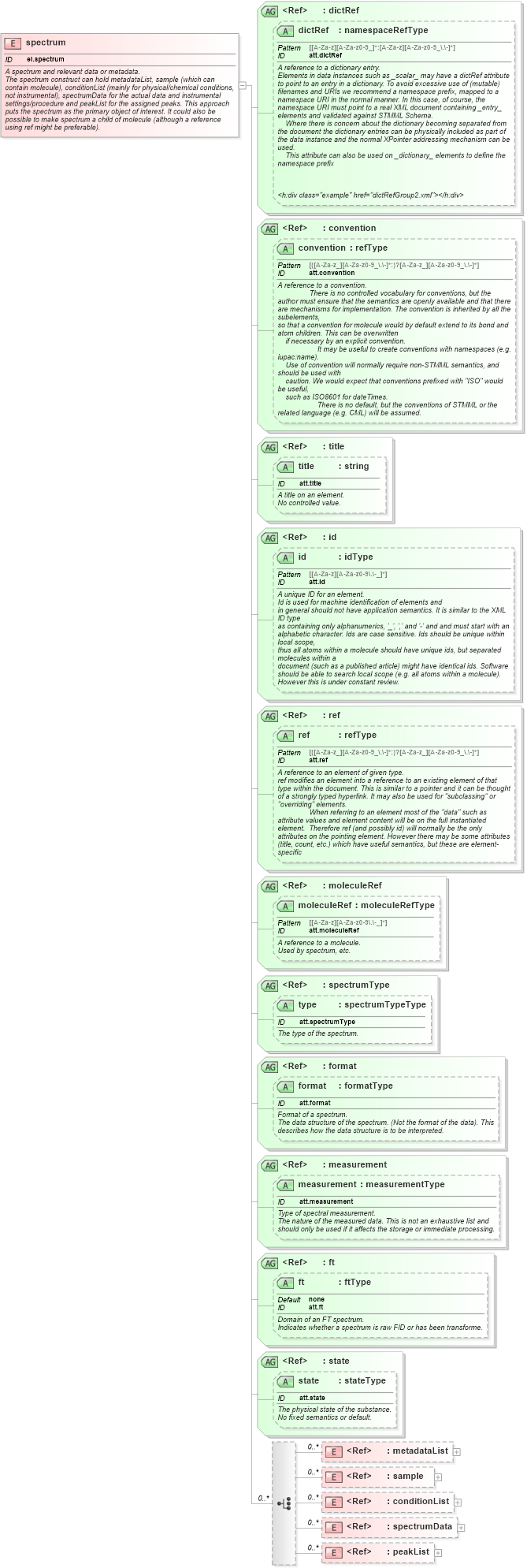
<xsd:element name="spectrum" id="el.spectrum">
    <xsd:annotation>
        <xsd:documentation>
            <h:div class="summary" xmlns:h="http://www.w3.org/1999/xhtml">A spectrum and relevant data or metadata.</h:div>
            <h:div class="description" xmlns:h="http://www.w3.org/1999/xhtml">The <h:tt>spectrum</h:tt> construct can hold <h:tt>metadataList</h:tt>, <h:tt>sample</h:tt> (which can contain molecule), <h:tt>conditionList</h:tt> (mainly for physical/chemical conditions, not instrumental), <h:tt>spectrumData</h:tt> for the actual data and instrumental settings/procedure and <h:tt>peakList</h:tt> for the assigned peaks. This approach puts the spectrum as the primary object of interest. It could also be possible to make <h:tt>spectrum</h:tt> a child of <h:tt>molecule</h:tt> (although a reference using <h:tt>ref</h:tt> might be preferable).</h:div>
            <h:div class="example" href="spectrum1.xml" xmlns:h="http://www.w3.org/1999/xhtml" />
        </xsd:documentation>
    </xsd:annotation>
    <xsd:complexType>
        <xsd:choice minOccurs="0" maxOccurs="unbounded">
            <xsd:element ref="metadataList" minOccurs="0" maxOccurs="unbounded" />
            <xsd:element ref="sample" minOccurs="0" maxOccurs="unbounded">
                <xsd:annotation>
                    <xsd:documentation>
                        <h:div xmlns:h="http://www.w3.org/1999/xhtml">A (complete) description of the thing to which the spectrum relates. May contain <h:tt>molecule</h:tt> or <h:tt>substanceList</h:tt>. Solvents, mulls, etc should be described here.</h:div>
                    </xsd:documentation>
                </xsd:annotation>
            </xsd:element>
            <xsd:element ref="conditionList" minOccurs="0" maxOccurs="unbounded">
                <xsd:annotation>
                    <xsd:documentation>
                        <h:div xmlns:h="http://www.w3.org/1999/xhtml">The conditions relating to the spectrum (complementary to substanceList.</h:div>
                    </xsd:documentation>
                </xsd:annotation>
            </xsd:element>
            <xsd:element ref="spectrumData" minOccurs="0" maxOccurs="unbounded" />
            <xsd:element ref="peakList" minOccurs="0" maxOccurs="unbounded">
                <xsd:annotation>
                    <xsd:documentation>
                        <h:div xmlns:h="http://www.w3.org/1999/xhtml">A list of peaks. This may occur independently of the xaxis/yaxis data.</h:div>
                    </xsd:documentation>
                </xsd:annotation>
            </xsd:element>
        </xsd:choice>
        <xsd:attributeGroup ref="dictRef" />
        <xsd:attributeGroup ref="convention" />
        <xsd:attributeGroup ref="title" />
        <xsd:attributeGroup ref="id" />
        <xsd:attributeGroup ref="ref" />
        <xsd:attributeGroup ref="moleculeRef">
            <xsd:annotation>
                <xsd:documentation>
                    <h:div class="specific" xmlns:h="http://www.w3.org/1999/xhtml">The molecule to which the spectrum refers.</h:div>
                </xsd:documentation>
            </xsd:annotation>
        </xsd:attributeGroup>
        <xsd:attributeGroup ref="spectrumType" />
        <xsd:attributeGroup ref="format" />
        <xsd:attributeGroup ref="measurement" />
        <xsd:attributeGroup ref="ft" />
        <xsd:attributeGroup ref="state">
            <xsd:annotation>
                <xsd:documentation>
                    <h:div class="specific" xmlns:h="http://www.w3.org/1999/xhtml">Although this may also be contained in the <h:tt>sample</h:tt> element it is useful to state it here. No default.</h:div>
                </xsd:documentation>
            </xsd:annotation>
        </xsd:attributeGroup>
    </xsd:complexType>
</xsd:element>
|
 XSD Schema Diagram: