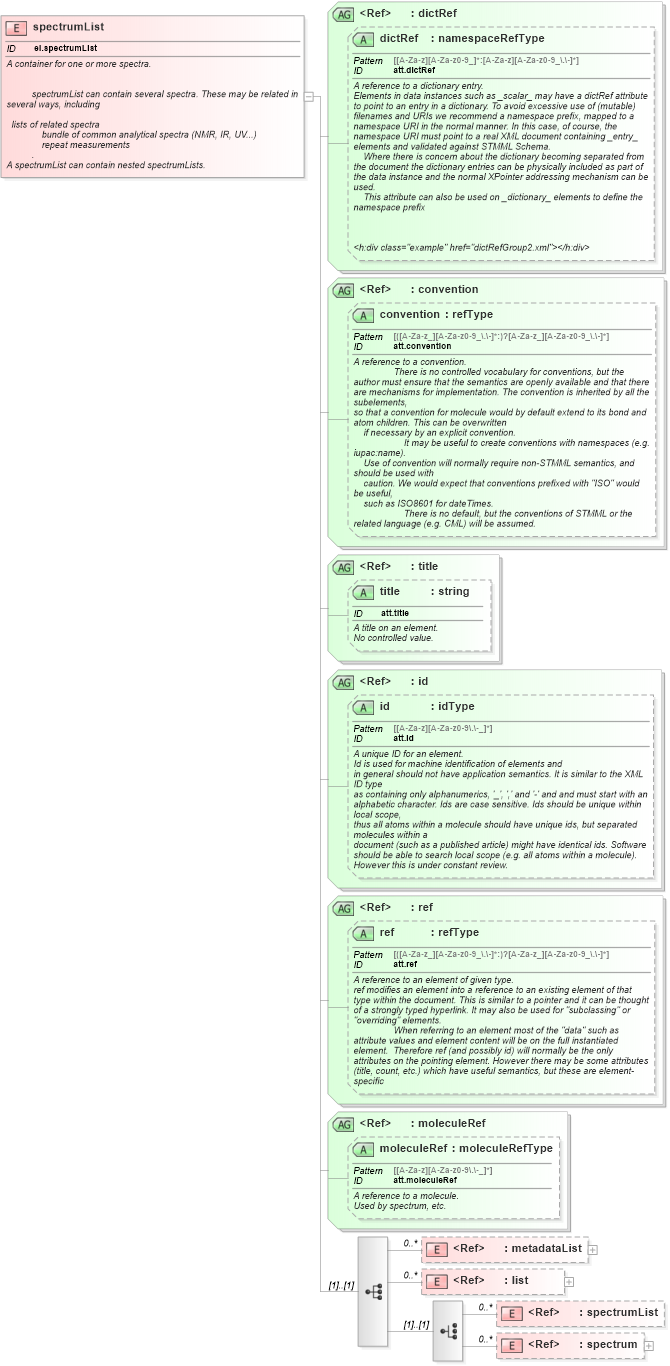
<xsd:element name="spectrumList" id="el.spectrumList">
    <xsd:annotation>
        <xsd:documentation>
            <h:div class="summary" xmlns:h="http://www.w3.org/1999/xhtml">A container for one or more spectra.</h:div>
            <h:div class="description" xmlns:h="http://www.w3.org/1999/xhtml">
                <h:p>
                    <h:tt>spectrumList</h:tt> can contain several spectra. These may be related in several ways, including
          <h:ul><h:li>lists of related spectra</h:li>
                        <h:li>bundle of common analytical spectra (NMR, IR, UV...)</h:li>
                        <h:li>repeat measurements</h:li>
                    </h:ul>.
          A spectrumList can contain nested spectrumLists.
        </h:p>
            </h:div>
            <h:div class="example" href="spectrumList1.xml" xmlns:h="http://www.w3.org/1999/xhtml" />
        </xsd:documentation>
    </xsd:annotation>
    <xsd:complexType>
        <xsd:annotation>
            <xsd:documentation>
                <h:div xmlns:h="http://www.w3.org/1999/xhtml">
                    <h:tt>metadataList</h:tt> contains <h:tt>metadata</h:tt>. <h:tt>list</h:tt> is for experimental and other data. <h:tt>spectrumList</h:tt> normally contains <h:tt>spectrum</h:tt>s but we make provision for nested spectrumLists if required. The <h:tt>molecule</h:tt>s can be a set of reference molecules which occur in the <h:tt>spectrum</h:tt>s and can be referenced. This makes the spectrums more readable and normalizes data when molecules are used more than once.</h:div>
            </xsd:documentation>
        </xsd:annotation>
        <xsd:sequence>
            <xsd:element ref="metadataList" minOccurs="0" maxOccurs="unbounded" />
            <xsd:element ref="list" minOccurs="0" maxOccurs="unbounded" />
            <xsd:choice>
                <xsd:element ref="spectrumList" minOccurs="0" maxOccurs="unbounded" />
                <xsd:element ref="spectrum" minOccurs="0" maxOccurs="unbounded" />
            </xsd:choice>
        </xsd:sequence>
        <xsd:attributeGroup ref="dictRef" />
        <xsd:attributeGroup ref="convention" />
        <xsd:attributeGroup ref="title" />
        <xsd:attributeGroup ref="id" />
        <xsd:attributeGroup ref="ref" />
        <xsd:attributeGroup ref="moleculeRef" />
    </xsd:complexType>
</xsd:element>
|
 XSD Schema Diagram: