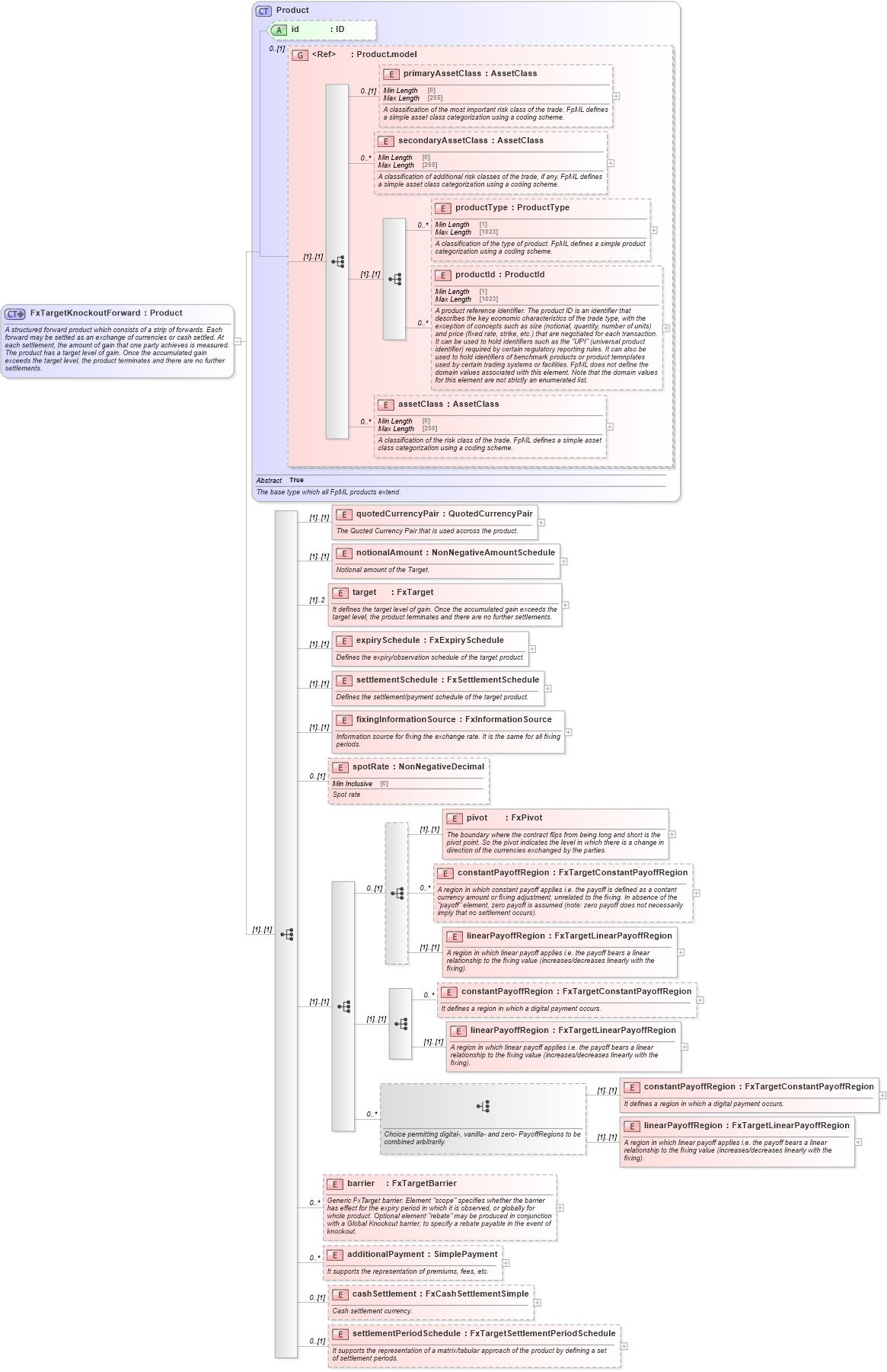
<xsd:complexType name="FxTargetKnockoutForward">
    <xsd:annotation>
        <xsd:documentation xml:lang="en">A structured forward product which consists of a strip of forwards. Each forward may be settled as an exchange of currencies or cash settled. At each settlement, the amount of gain that one party achieves is measured. The product has a target level of gain. Once the accumulated gain exceeds the target level, the product terminates and there are no further settlements.</xsd:documentation>
    </xsd:annotation>
    <xsd:complexContent>
        <xsd:extension base="Product">
            <xsd:sequence>
                <xsd:element name="quotedCurrencyPair" type="QuotedCurrencyPair">
                    <xsd:annotation>
                        <xsd:documentation xml:lang="en">The Quoted Currency Pair that is used accross the product.</xsd:documentation>
                    </xsd:annotation>
                </xsd:element>
                <xsd:element name="notionalAmount" type="NonNegativeAmountSchedule">
                    <xsd:annotation>
                        <xsd:documentation xml:lang="en">Notional amount of the Target.</xsd:documentation>
                    </xsd:annotation>
                </xsd:element>
                <xsd:element name="target" type="FxTarget" maxOccurs="2">
                    <xsd:annotation>
                        <xsd:documentation xml:lang="en">It defines the target level of gain. Once the accumulated gain exceeds the target level, the product terminates and there are no further settlements.</xsd:documentation>
                    </xsd:annotation>
                </xsd:element>
                <xsd:element name="expirySchedule" type="FxExpirySchedule">
                    <xsd:annotation>
                        <xsd:documentation xml:lang="en">Defines the expiry/observation schedule of the target product.</xsd:documentation>
                    </xsd:annotation>
                </xsd:element>
                <xsd:element name="settlementSchedule" type="FxSettlementSchedule">
                    <xsd:annotation>
                        <xsd:documentation xml:lang="en">Defines the settlement/payment schedule of the target product.</xsd:documentation>
                    </xsd:annotation>
                </xsd:element>
                <xsd:element name="fixingInformationSource" type="FxInformationSource">
                    <xsd:annotation>
                        <xsd:documentation xml:lang="en">Information source for fixing the exchange rate. It is the same for all fixing periods.</xsd:documentation>
                    </xsd:annotation>
                </xsd:element>
                <xsd:element name="spotRate" type="NonNegativeDecimal" minOccurs="0">
                    <xsd:annotation>
                        <xsd:documentation xml:lang="en">Spot rate</xsd:documentation>
                    </xsd:annotation>
                </xsd:element>
                <xsd:sequence>
                    <xsd:sequence minOccurs="0">
                        <xsd:element name="pivot" type="FxPivot">
                            <xsd:annotation>
                                <xsd:documentation xml:lang="en">The boundary where the contract flips from being long and short is the pivot point. So the pivot indicates the level in which there is a change in direction of the currencies exchanged by the parties.</xsd:documentation>
                            </xsd:annotation>
                        </xsd:element>
                        <xsd:element name="constantPayoffRegion" type="FxTargetConstantPayoffRegion" minOccurs="0" maxOccurs="unbounded">
                            <xsd:annotation>
                                <xsd:documentation xml:lang="en">A region in which constant payoff applies i.e. the payoff is defined as a contant currency amount or fixing adjustment, unrelated to the fixing. In absence of the "payoff" element, zero payoff is assumed (note: zero payoff does not necessarily imply that no settlement occurs).</xsd:documentation>
                            </xsd:annotation>
                        </xsd:element>
                        <xsd:element name="linearPayoffRegion" type="FxTargetLinearPayoffRegion">
                            <xsd:annotation>
                                <xsd:documentation xml:lang="en">A region in which linear payoff applies i.e. the payoff bears a linear relationship to the fixing value (increases/decreases linearly with the fixing).</xsd:documentation>
                            </xsd:annotation>
                        </xsd:element>
                    </xsd:sequence>
                    <xsd:sequence>
                        <xsd:element name="constantPayoffRegion" type="FxTargetConstantPayoffRegion" minOccurs="0" maxOccurs="unbounded">
                            <xsd:annotation>
                                <xsd:documentation xml:lang="en">It defines a region in which a digital payment occurs.</xsd:documentation>
                            </xsd:annotation>
                        </xsd:element>
                        <xsd:element name="linearPayoffRegion" type="FxTargetLinearPayoffRegion">
                            <xsd:annotation>
                                <xsd:documentation xml:lang="en">A region in which linear payoff applies i.e. the payoff bears a linear relationship to the fixing value (increases/decreases linearly with the fixing).</xsd:documentation>
                            </xsd:annotation>
                        </xsd:element>
                    </xsd:sequence>
                    <xsd:choice minOccurs="0" maxOccurs="unbounded">
                        <xsd:annotation>
                            <xsd:documentation xml:lang="en">Choice permitting digital-, vanilla- and zero- PayoffRegions to be combined arbitrarily.</xsd:documentation>
                        </xsd:annotation>
                        <xsd:element name="constantPayoffRegion" type="FxTargetConstantPayoffRegion">
                            <xsd:annotation>
                                <xsd:documentation xml:lang="en">It defines a region in which a digital payment occurs.</xsd:documentation>
                            </xsd:annotation>
                        </xsd:element>
                        <xsd:element name="linearPayoffRegion" type="FxTargetLinearPayoffRegion">
                            <xsd:annotation>
                                <xsd:documentation xml:lang="en">A region in which linear payoff applies i.e. the payoff bears a linear relationship to the fixing value (increases/decreases linearly with the fixing).</xsd:documentation>
                            </xsd:annotation>
                        </xsd:element>
                    </xsd:choice>
                </xsd:sequence>
                <xsd:element name="barrier" type="FxTargetBarrier" minOccurs="0" maxOccurs="unbounded">
                    <xsd:annotation>
                        <xsd:documentation xml:lang="en">Generic FxTarget barrier. Element "scope" specifies whether the barrier has effect for the expiry period in which it is observed, or globally for whole product. Optional element "rebate" may be produced in conjunction with a Global Knockout barrier, to specify a rebate payable in the event of knockout.</xsd:documentation>
                    </xsd:annotation>
                </xsd:element>
                <xsd:element name="additionalPayment" type="SimplePayment" minOccurs="0" maxOccurs="unbounded">
                    <xsd:annotation>
                        <xsd:documentation xml:lang="en">It supports the representation of premiums, fees, etc.</xsd:documentation>
                    </xsd:annotation>
                </xsd:element>
                <xsd:element name="cashSettlement" type="FxCashSettlementSimple" minOccurs="0">
                    <xsd:annotation>
                        <xsd:documentation xml:lang="en">Cash settlement currency.</xsd:documentation>
                    </xsd:annotation>
                </xsd:element>
                <xsd:element name="settlementPeriodSchedule" type="FxTargetSettlementPeriodSchedule" minOccurs="0">
                    <xsd:annotation>
                        <xsd:documentation xml:lang="en">It supports the representation of a matrix/tabular approach of the product by defining a set of settlement periods.</xsd:documentation>
                    </xsd:annotation>
                </xsd:element>
            </xsd:sequence>
        </xsd:extension>
    </xsd:complexContent>
</xsd:complexType>
|
 XSD Schema Diagram: