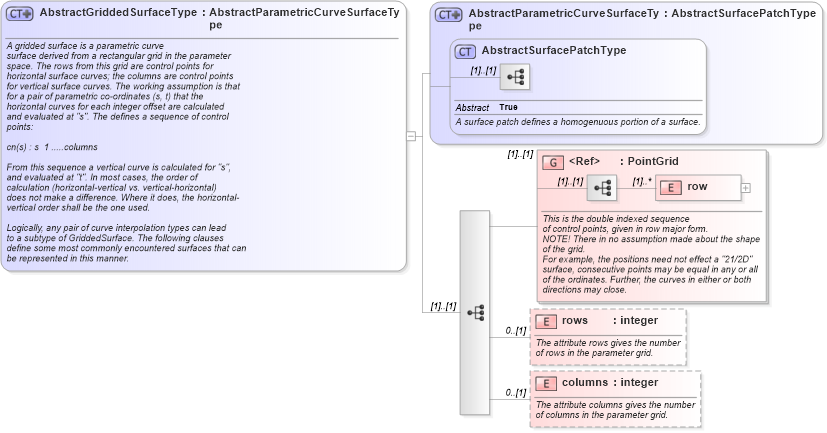
<complexType name="AbstractGriddedSurfaceType">
    <annotation>
        <documentation>A gridded surface is a parametric curve
   surface derived from a rectangular grid in the parameter
   space. The rows from this grid are control points for
   horizontal surface curves; the columns are control points
   for vertical surface curves. The working assumption is that
   for a pair of parametric co-ordinates (s, t) that the
   horizontal curves for each integer offset are calculated
   and evaluated at "s". The defines a sequence of control
   points:

   cn(s) : s  1 .....columns

   From this sequence a vertical curve is calculated for "s",
   and evaluated at "t". In most cases, the order of
   calculation (horizontal-vertical vs. vertical-horizontal)
   does not make a difference. Where it does, the horizontal-
   vertical order shall be the one used.

   Logically, any pair of curve interpolation types can lead
   to a subtype of GriddedSurface. The following clauses
   define some most commonly encountered surfaces that can
   be represented in this manner.</documentation>
    </annotation>
    <complexContent>
        <extension base="gml:AbstractParametricCurveSurfaceType">
            <sequence>
                <group ref="gml:PointGrid">
                    <annotation>
                        <documentation>This is the double indexed sequence
       of control points, given in row major form.
       NOTE! There in no assumption made about the shape
       of the grid.
       For example, the positions need not effect a "21/2D"
       surface, consecutive points may be equal in any or all
       of the ordinates. Further, the curves in either or both
       directions may close.</documentation>
                    </annotation>
                </group>
                <element name="rows" type="integer" minOccurs="0">
                    <annotation>
                        <documentation>The attribute rows gives the number
         of rows in the parameter grid.</documentation>
                    </annotation>
                </element>
                <element name="columns" type="integer" minOccurs="0">
                    <annotation>
                        <documentation>The attribute columns gives the number
        of columns in the parameter grid.</documentation>
                    </annotation>
                </element>
            </sequence>
        </extension>
    </complexContent>
</complexType>
|
 XSD Schema Diagram: