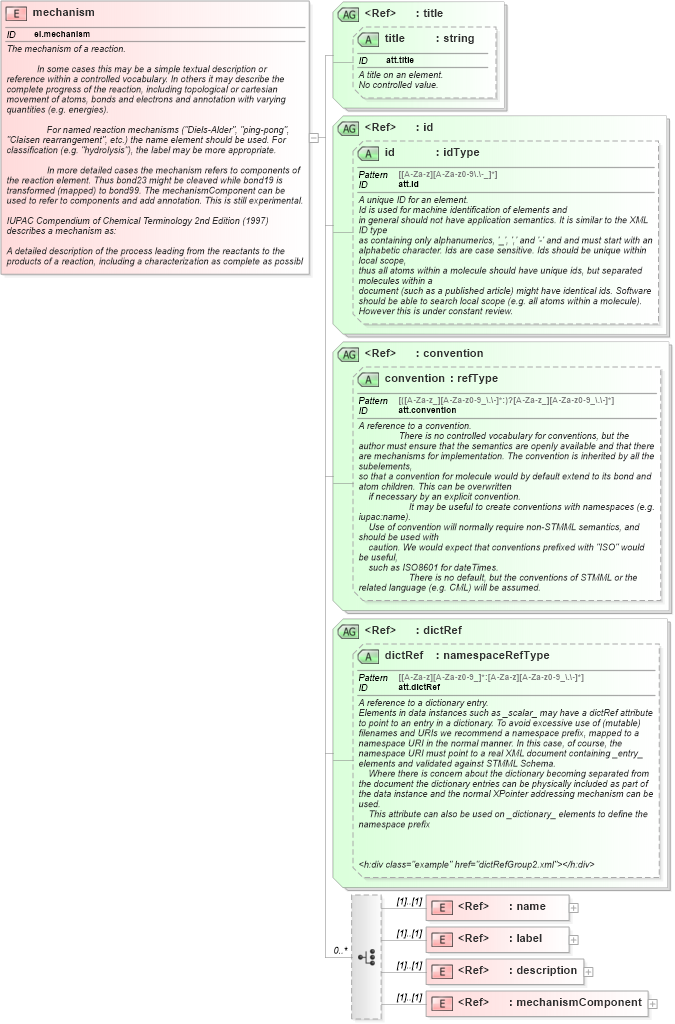
<xsd:element name="mechanism" id="el.mechanism">
    <xsd:annotation>
        <xsd:documentation>
            <h:div class="summary" xmlns:h="http://www.w3.org/1999/xhtml">The mechanism of a reaction.</h:div>
            <h:div class="description" xmlns:h="http://www.w3.org/1999/xhtml">
                <h:p>In some cases this may be a simple textual description or reference within a controlled vocabulary. In others it may describe the complete progress of the reaction, including topological or cartesian movement of atoms, bonds and electrons and annotation with varying quantities (e.g. energies). </h:p>
                <h:p>
                For named reaction mechanisms ("Diels-Alder", "ping-pong", "Claisen rearrangement", etc.) the <h:tt>name</h:tt> element should be used. For classification (e.g. "hydrolysis"), the <h:tt>label</h:tt> may be more appropriate.
                </h:p>
                <h:p>In more detailed cases the mechanism refers to components of the <h:tt>reaction</h:tt> element. Thus bond23 might be cleaved while bond19 is transformed (mapped) to bond99. The <h:tt>mechanismComponent</h:tt> can be used to refer to components and add annotation. This is still experimental.</h:p>
            </h:div>
            <h:div class="description" xmlns:h="http://www.w3.org/1999/xhtml">
                <h:p>IUPAC Compendium of Chemical Terminology 2nd Edition (1997) describes a mechanism as:

<h:blockquote>A detailed description of the process leading from the reactants to the
products of a reaction, including a characterization as complete as possible
of the composition, structure, energy and other properties of reaction
intermediates, products and transition states. An acceptable mechanism of
a specified reaction (and there may be a number of such alternative mechanisms
not excluded by the evidence) must be consistent with the reaction
stoichiometry, the rate law and with all other available experimental data,
such as the stereochemical course of the reaction. Inferences concerning
the electronic motions which dynamically interconvert successive species
along the reaction path (as represented by curved arrows, for example) are
often included in the description of a mechanism.
It should be noted that for many reactions all this information is not
available and the suggested mechanism is based on incomplete experimental
data. It is not appropriate to use the term mechanism to describe a
statement of the probable sequence in a set of stepwise reactions. That
should be referred to as a reaction sequence, and not a mechanism.</h:blockquote>
                </h:p>
                <h:p>CMLReact provides reactionScheme and annotions to describe the reaction sequence and both it and <h:tt>mechanism</h:tt> could co-occur within a reactionScheme container.</h:p>
            </h:div>
            <h:div class="curation" xmlns:h="http://www.w3.org/1999/xhtml">2006-02-28 PMR: changed content model to choice.</h:div>
            <h:div class="example" href="mechanism1.xml" xmlns:h="http://www.w3.org/1999/xhtml" />
        </xsd:documentation>
    </xsd:annotation>
    <xsd:complexType>
        <xsd:choice minOccurs="0" maxOccurs="unbounded">
            <xsd:element ref="name" />
            <xsd:element ref="label" />
            <xsd:element ref="description" />
            <xsd:element ref="mechanismComponent" />
        </xsd:choice>
        <xsd:attributeGroup ref="title" />
        <xsd:attributeGroup ref="id" />
        <xsd:attributeGroup ref="convention" />
        <xsd:attributeGroup ref="dictRef" />
    </xsd:complexType>
</xsd:element>
|
 XSD Schema Diagram: