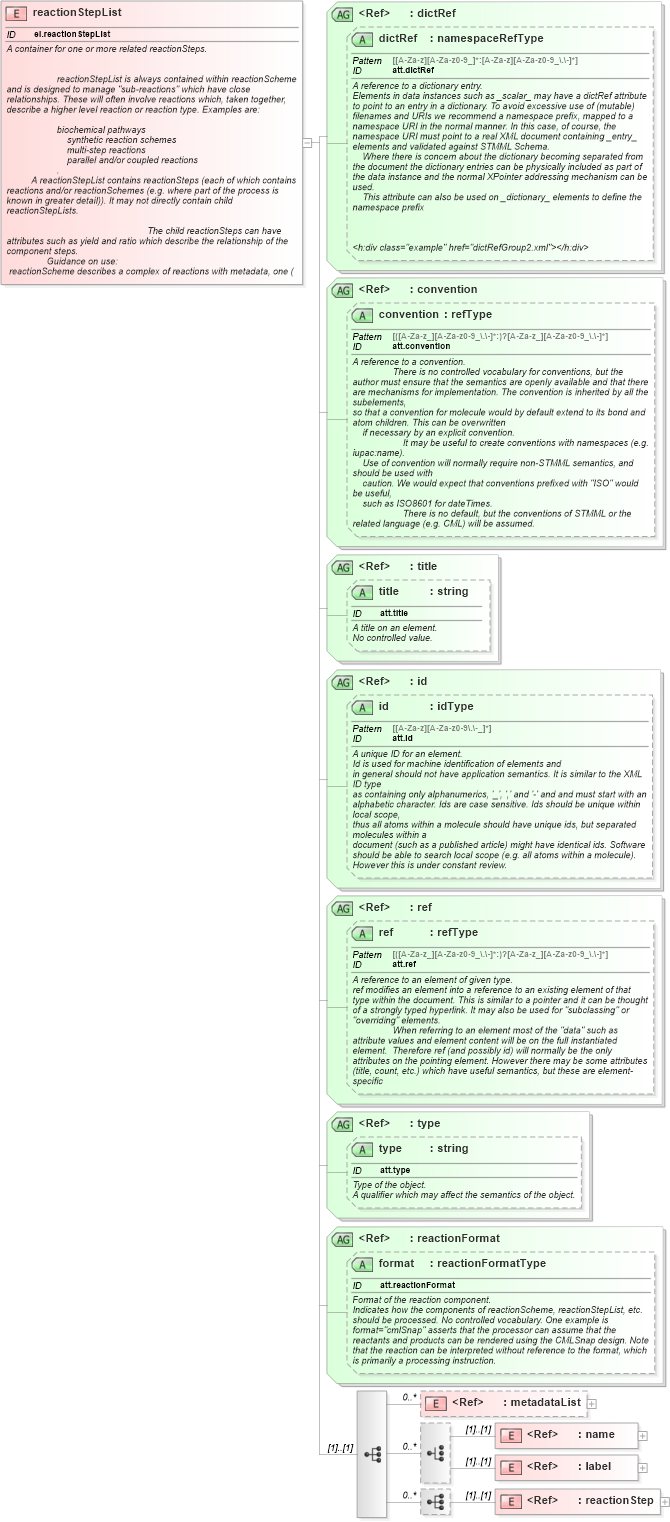
<xsd:element name="reactionStepList" id="el.reactionStepList">
    <xsd:annotation>
        <xsd:documentation>
            <h:div class="summary" xmlns:h="http://www.w3.org/1999/xhtml">A container for one or more related reactionSteps.</h:div>
            <h:div class="description" xmlns:h="http://www.w3.org/1999/xhtml">
                <h:p>
                    <h:tt>reactionStepList</h:tt> is always contained within reactionScheme and is designed to manage "sub-reactions" which have close relationships. These will often involve reactions which, taken together, describe a higher level reaction or reaction type. Examples are:
          <h:ul><h:li>biochemical pathways</h:li>
                        <h:li>synthetic reaction schemes</h:li>
                        <h:li>multi-step reactions</h:li>
                        <h:li>parallel and/or coupled reactions</h:li>
                    </h:ul>.
          A reactionStepList contains reactionSteps (each of which contains reactions and/or reactionSchemes (e.g. where part of the process is known in greater detail)). It may not directly contain child reactionStepLists.
        </h:p>
                <h:p>The child reactionSteps can have attributes such as yield and ratio which describe the relationship of the component steps.</h:p>
                <h:p>Guidance on use: <h:ul><h:li>reactionScheme describes a complex of reactions with metadata, one (or more) overall reactions and a reactionStepList with the overall component reactions.</h:li>
                        <h:li> reactionStepList aggregates and structures the individual subreactions.
</h:li>
                        <h:li>reactionList is a container for reactions and reactionSchemes with no semantics (e.g. a book or database of selected reactions).
</h:li>
                    </h:ul>
                </h:p>
            </h:div>
            <h:div class="example" href="reactionStepList1.xml" xmlns:h="http://www.w3.org/1999/xhtml" />
            <h:div class="example" href="reactionStepList3.xml" xmlns:h="http://www.w3.org/1999/xhtml" />
        </xsd:documentation>
    </xsd:annotation>
    <xsd:complexType>
        <xsd:annotation>
            <xsd:documentation>
                <h:div xmlns:h="http://www.w3.org/1999/xhtml">
                    <h:p>
      The <h:tt>name</h:tt> applies to the overall schema of reactions. <h:tt>label</h:tt> is for additional textual information and classification. <h:tt>reactionStepList</h:tt> normally contains <h:tt>reactionStep</h:tt>s. </h:p>
                </h:div>
            </xsd:documentation>
        </xsd:annotation>
        <xsd:sequence>
            <xsd:element ref="metadataList" minOccurs="0" maxOccurs="unbounded" />
            <xsd:choice minOccurs="0" maxOccurs="unbounded">
                <xsd:element ref="name" />
                <xsd:element ref="label" />
            </xsd:choice>
            <xsd:sequence minOccurs="0" maxOccurs="unbounded">
                <xsd:element ref="reactionStep" />
            </xsd:sequence>
        </xsd:sequence>
        <xsd:attributeGroup ref="dictRef" />
        <xsd:attributeGroup ref="convention" />
        <xsd:attributeGroup ref="title" />
        <xsd:attributeGroup ref="id" />
        <xsd:attributeGroup ref="ref" />
        <xsd:attributeGroup ref="type" />
        <xsd:attributeGroup ref="reactionFormat" />
    </xsd:complexType>
</xsd:element>
|
 XSD Schema Diagram: