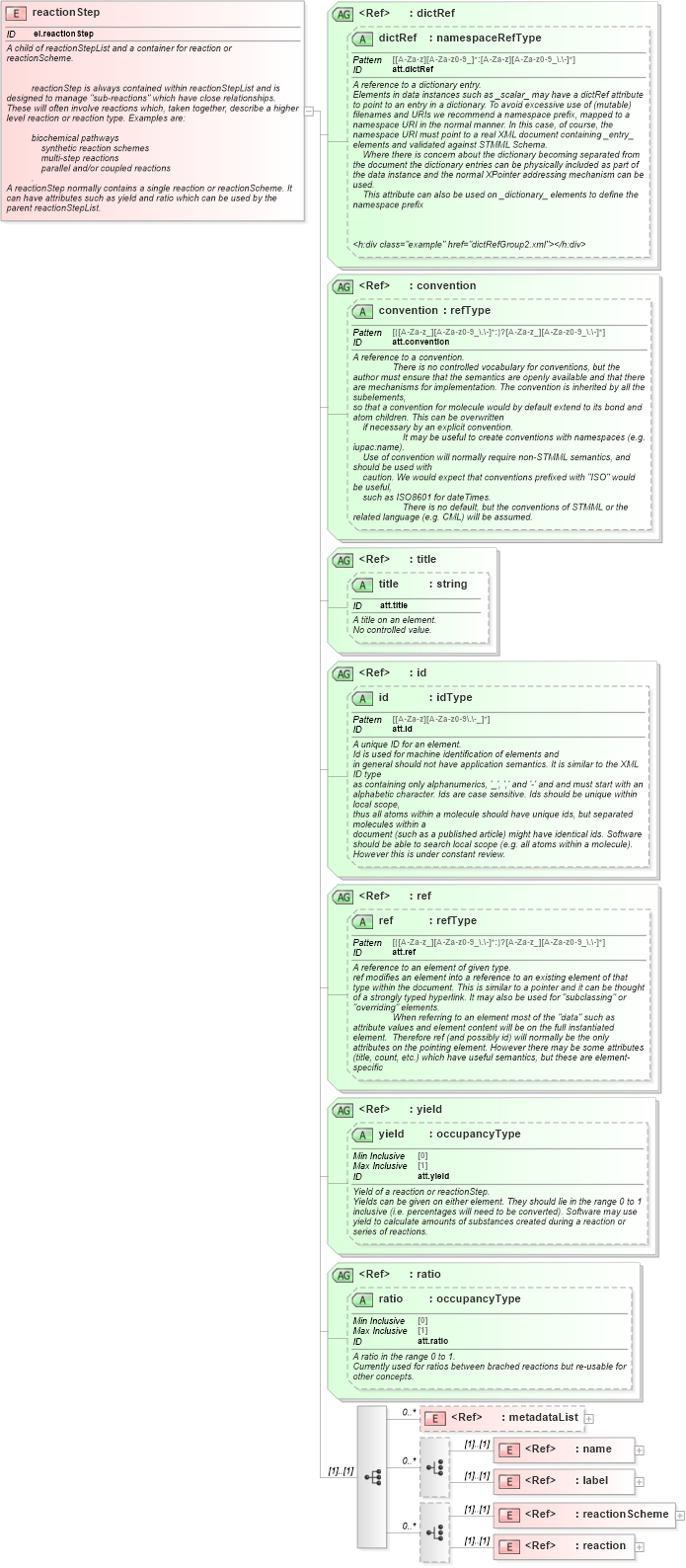
<xsd:element name="reactionStep" id="el.reactionStep">
    <xsd:annotation>
        <xsd:documentation>
            <h:div class="summary" xmlns:h="http://www.w3.org/1999/xhtml">A child of reactionStepList and a container for reaction or reactionScheme.</h:div>
            <h:div class="description" xmlns:h="http://www.w3.org/1999/xhtml">
                <h:p>
                    <h:tt>reactionStep</h:tt> is always contained within reactionStepList and is designed to manage "sub-reactions" which have close relationships. These will often involve reactions which, taken together, describe a higher level reaction or reaction type. Examples are:
          <h:ul><h:li>biochemical pathways</h:li>
                        <h:li>synthetic reaction schemes</h:li>
                        <h:li>multi-step reactions</h:li>
                        <h:li>parallel and/or coupled reactions</h:li>
                    </h:ul>.
          A reactionStep normally contains a single reaction or reactionScheme. It can have attributes such as yield and ratio which can be used by the parent reactionStepList.
        </h:p>
            </h:div>
            <h:div class="example" href="reactionStepList4.xml" xmlns:h="http://www.w3.org/1999/xhtml" />
            <h:div class="example" href="reactionStepList5a.xml" xmlns:h="http://www.w3.org/1999/xhtml" />
            <h:div class="example" href="reactionStepList5b.xml" xmlns:h="http://www.w3.org/1999/xhtml" />
        </xsd:documentation>
    </xsd:annotation>
    <xsd:complexType>
        <xsd:annotation>
            <xsd:documentation>
                <h:div xmlns:h="http://www.w3.org/1999/xhtml">
                    <h:p>
      The <h:tt>name</h:tt> applies to the overall schema of reactions. <h:tt>label</h:tt> is for additional textual information and classification. <h:tt>reactionStepList</h:tt> normally contains <h:tt>reaction</h:tt>s but we make provision for nested reactionSchemes if required. </h:p>
                </h:div>
            </xsd:documentation>
        </xsd:annotation>
        <xsd:sequence>
            <xsd:element ref="metadataList" minOccurs="0" maxOccurs="unbounded" />
            <xsd:choice minOccurs="0" maxOccurs="unbounded">
                <xsd:element ref="name" />
                <xsd:element ref="label" />
            </xsd:choice>
            <xsd:choice minOccurs="0" maxOccurs="unbounded">
                <xsd:element ref="reactionScheme" />
                <xsd:element ref="reaction" />
            </xsd:choice>
        </xsd:sequence>
        <xsd:attributeGroup ref="dictRef" />
        <xsd:attributeGroup ref="convention" />
        <xsd:attributeGroup ref="title" />
        <xsd:attributeGroup ref="id" />
        <xsd:attributeGroup ref="ref" />
        <xsd:attributeGroup ref="yield">
            <xsd:annotation>
                <xsd:documentation>
                    <h:div class="specific" xmlns:h="http://www.w3.org/1999/xhtml">
                        <h:p>The yield of the reactionStep. Note that this lies in the range 0-1.</h:p>
                    </h:div>
                </xsd:documentation>
            </xsd:annotation>
        </xsd:attributeGroup>
        <xsd:attributeGroup ref="ratio">
            <xsd:annotation>
                <xsd:documentation>
                    <h:div class="specific" xmlns:h="http://www.w3.org/1999/xhtml">
                        <h:p>The ratio of this step to one or more sibling steps. Note that this lies in the range 0-1. It is meaningless to use this unless there are siblings, in which case it refers to the relative molar fluxes through each. The "percentage yields" will need to be transformed to this range. There is no requirement that the sum of fluxes through a group of siblings sum to 1.0, though they should not sum to more.</h:p>
                    </h:div>
                </xsd:documentation>
            </xsd:annotation>
        </xsd:attributeGroup>
    </xsd:complexType>
</xsd:element>
|
 XSD Schema Diagram: