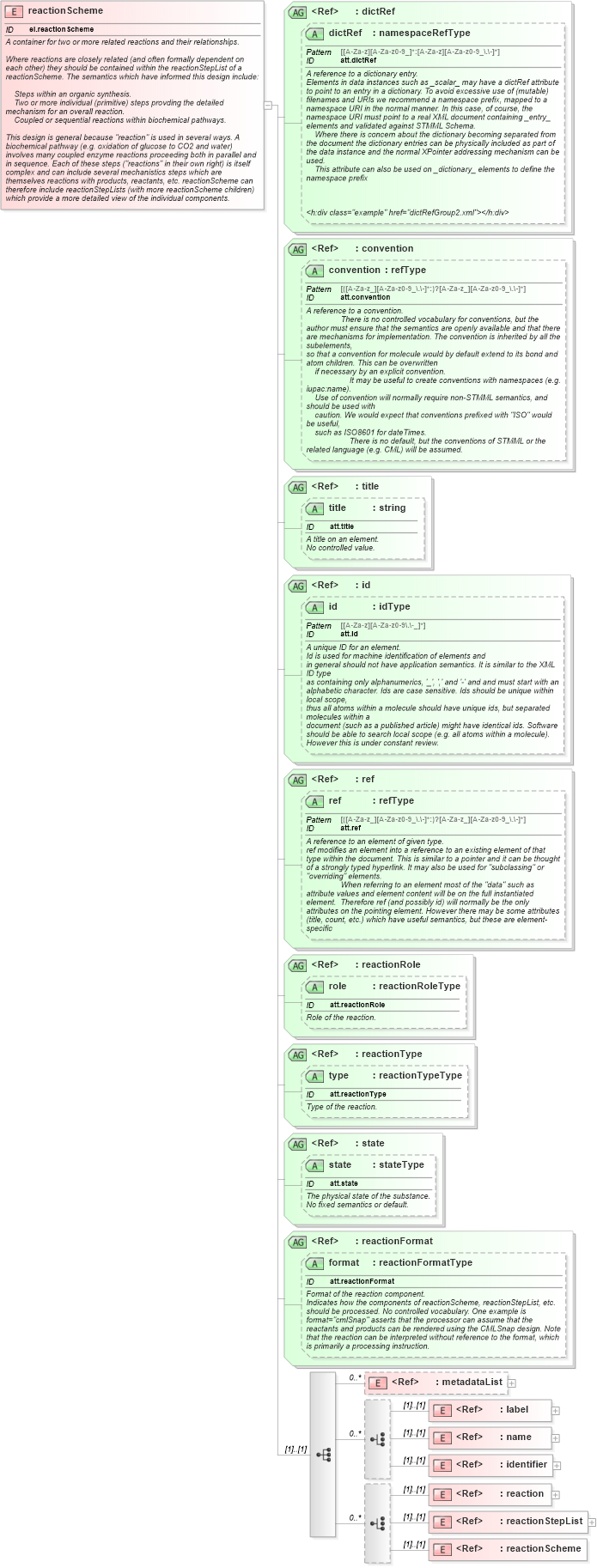
<xsd:element name="reactionScheme" id="el.reactionScheme">
    <xsd:annotation>
        <xsd:documentation>
            <h:div class="summary" xmlns:h="http://www.w3.org/1999/xhtml">A container for two or more related reactions and their relationships.</h:div>
            <h:div class="description" xmlns:h="http://www.w3.org/1999/xhtml">
                Where reactions are closely related (and often formally dependent on each other) they should be contained within the reactionStepList of a reactionScheme. The semantics which have informed this design include:
                <h:ul><h:li>Steps within an organic synthesis.</h:li>
                    <h:li>Two or more individual (primitive) steps provding the detailed mechanism for an overall reaction.</h:li>
                    <h:li>Coupled or sequential reactions within biochemical pathways.</h:li>
                </h:ul>
                <h:p>This design is general because "reaction" is used in several ways. A biochemical pathway (e.g. oxidation of glucose to CO2 and water) involves many coupled enzyme reactions proceeding both in parallel and in sequence. Each of these steps ("reactions" in their own right) is itself complex and can include several mechanistics steps which are themselves reactions with products, reactants, etc. <h:tt>reactionScheme</h:tt> can therefore include reactionStepLists (with more reactionScheme children) which provide a more detailed view of the individual components.</h:p>
                <h:p>Where a set of reactions are primitives...</h:p>
            </h:div>
            <h:div class="example" href="reactionScheme1.xml" xmlns:h="http://www.w3.org/1999/xhtml" />
            <h:div class="example" href="reactionScheme3.xml" xmlns:h="http://www.w3.org/1999/xhtml" />
            <h:div class="example" href="reactionScheme4a.xml" xmlns:h="http://www.w3.org/1999/xhtml" />
            <h:div class="example" href="reactionScheme4b.xml" xmlns:h="http://www.w3.org/1999/xhtml" />
        </xsd:documentation>
    </xsd:annotation>
    <xsd:complexType>
        <xsd:annotation>
            <xsd:documentation>
                <h:div class="description" xmlns:h="http://www.w3.org/1999/xhtml">
                    <h:p>The semantics of the content model are</h:p>
                    <h:ul>
                        <h:li>metadataList for general metadata</h:li>
                        <h:li>label for classifying or describing the reaction (e.g. "hydrolysis")</h:li>
                        <h:li>identifier for unique identification. This could be a classification such as EC (enzyme commission) or an IChI-like string generated from the components.</h:li>
                        <h:li>these are followed by the possible components of the reaction and/or a reactionList of further details.</h:li>
                    </h:ul>
                </h:div>
            </xsd:documentation>
        </xsd:annotation>
        <xsd:sequence>
            <xsd:element ref="metadataList" minOccurs="0" maxOccurs="unbounded" />
            <xsd:choice minOccurs="0" maxOccurs="unbounded">
                <xsd:element ref="label" />
                <xsd:element ref="name" />
                <xsd:element ref="identifier" />
            </xsd:choice>
            <xsd:choice minOccurs="0" maxOccurs="unbounded">
                <xsd:element ref="reaction" />
                <xsd:element ref="reactionStepList" />
                <xsd:element ref="reactionScheme" />
            </xsd:choice>
        </xsd:sequence>
        <xsd:attributeGroup ref="dictRef" />
        <xsd:attributeGroup ref="convention" />
        <xsd:attributeGroup ref="title" />
        <xsd:attributeGroup ref="id" />
        <xsd:attributeGroup ref="ref" />
        <xsd:attributeGroup ref="reactionRole" />
        <xsd:attributeGroup ref="reactionType" />
        <xsd:attributeGroup ref="state" />
        <xsd:attributeGroup ref="reactionFormat" />
    </xsd:complexType>
</xsd:element>
|
 XSD Schema Diagram: