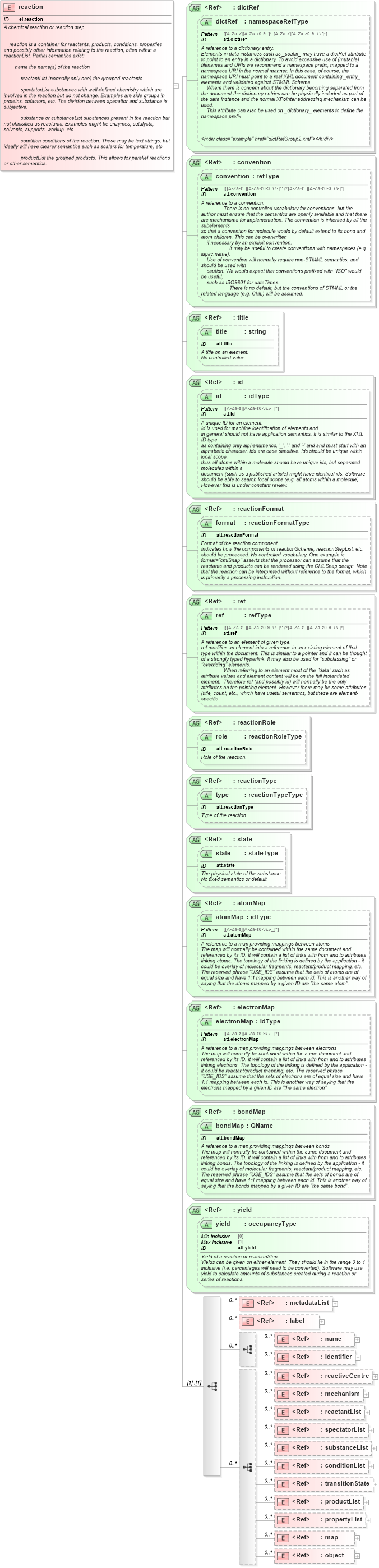
<xsd:element name="reaction" id="el.reaction">
    <xsd:annotation>
        <xsd:documentation>
            <h:div class="summary" xmlns:h="http://www.w3.org/1999/xhtml">A chemical reaction or reaction step.</h:div>
            <h:div class="description" xmlns:h="http://www.w3.org/1999/xhtml">
                <h:p>
                    <h:tt>reaction</h:tt> is a container for reactants, products, conditions, properties and possibly other information relating to the reaction, often within a reactionList. Partial semantics exist:
                    <h:ul><h:li><h:b>name</h:b> the name(s) of the reaction</h:li>
                        <h:li>
                            <h:b>reactantList</h:b> (normally only one) the grouped reactants</h:li>
                        <h:li>
                            <h:b>spectatorList</h:b> substances with well-defined chemistry which are involved in the reaction but do not change. Examples are side groups in proteins, cofactors, etc. The division between specattor and substance is subjective.</h:li>
                        <h:li>
                            <h:b>substance</h:b> or <h:b>substanceList</h:b> substances present in the reaction but not classified as reactants. Examples might be enzymes, catalysts, solvents, supports, workup, etc. </h:li>
                        <h:li>
                            <h:b>condition</h:b> conditions of the reaction. These may be text strings, but ideally will have clearer semantics such as scalars for temperature, etc.</h:li>
                        <h:li>
                            <h:b>productList</h:b> the grouped products. This allows for parallel reactions or other semantics.</h:li>
                        <h:li>
                            <h:b>property</h:b> properties (often physical) associated with the reaction. Examples might be heat of formation, kinetics or equilibrium constant.</h:li>
                    </h:ul>
                </h:p>
            </h:div>
            <h:div xmlns:h="http://www.w3.org/1999/xhtml">
                <h:p>Reaction normally refers to an overall reaction or a step within a reactionList. For a complex "reaction", such as in enzymes or chain reactions, it may be best to use <h:tt>reactionScheme</h:tt> to hold the overall <h:tt>reaction</h:tt> and a <h:tt>reactionList</h:tt> of the individual <h:tt>reaction</h:tt> steps.</h:p>
            </h:div>
            <h:div class="example" href="reaction1.xml" xmlns:h="http://www.w3.org/1999/xhtml" />
            <h:div class="example" href="reaction9a.xml" xmlns:h="http://www.w3.org/1999/xhtml" />
            <h:div class="example" href="reaction9b.xml" xmlns:h="http://www.w3.org/1999/xhtml" />
            <h:div class="example" href="reaction10a.xml" xmlns:h="http://www.w3.org/1999/xhtml" />
            <h:div class="example" href="reaction10b.xml" xmlns:h="http://www.w3.org/1999/xhtml" />
            <h:div class="example" href="reaction11.xml" xmlns:h="http://www.w3.org/1999/xhtml" />
        </xsd:documentation>
    </xsd:annotation>
    <xsd:complexType>
        <xsd:annotation>
            <xsd:documentation>
                <h:div xmlns:h="http://www.w3.org/1999/xhtml">
                    <h:p>The semantics of the content model are</h:p>
                    <h:ul>
                        <h:li>metadataList for general metadata</h:li>
                        <h:li>label for classifying or describing the reaction (e.g. "hydrolysis")</h:li>
                        <h:li>identifier for unique identification. This could be a classification such as EC (enzyme commission) or an IChI-like string generated from the components.</h:li>
                        <h:li>these are followed by the possible components of the reaction and/or a reactionList of further details.</h:li>
                    </h:ul>.</h:div>
            </xsd:documentation>
        </xsd:annotation>
        <xsd:sequence>
            <xsd:element ref="metadataList" minOccurs="0" maxOccurs="unbounded" />
            <xsd:element ref="label" minOccurs="0" maxOccurs="unbounded" />
            <xsd:choice minOccurs="0" maxOccurs="unbounded">
                <xsd:element ref="name" minOccurs="0" maxOccurs="unbounded" />
                <xsd:element ref="identifier" minOccurs="0" maxOccurs="unbounded" />
            </xsd:choice>
            <xsd:sequence minOccurs="0" maxOccurs="unbounded">
                <xsd:element ref="reactiveCentre" minOccurs="0" maxOccurs="unbounded" />
                <xsd:element ref="mechanism" minOccurs="0" maxOccurs="unbounded" />
                <xsd:element ref="reactantList" minOccurs="0" maxOccurs="unbounded" />
                <xsd:element ref="spectatorList" minOccurs="0" maxOccurs="unbounded" />
                <xsd:element ref="substanceList" minOccurs="0" maxOccurs="unbounded" />
                <xsd:element ref="conditionList" minOccurs="0" maxOccurs="unbounded" />
                <xsd:element ref="transitionState" minOccurs="0" maxOccurs="unbounded" />
                <xsd:element ref="productList" minOccurs="0" maxOccurs="unbounded" />
                <xsd:element ref="propertyList" minOccurs="0" maxOccurs="unbounded" />
                <xsd:element ref="map" minOccurs="0" maxOccurs="unbounded" />
                <xsd:element ref="object" minOccurs="0" maxOccurs="unbounded">
                    <xsd:annotation>
                        <xsd:documentation>
                            <h:div xmlns:h="http://www.w3.org/1999/xhtml">This allows any objects to be attached to the reaction, but particularly graphical primitives such as lines, arrows, etc. These should be provided as elements where possible (e.g. SVG) and should have references to the chemical objects they interact with (i.e. not simply relying on geometry). Markers with IDs can be included as part of the graphics object and their ids linked to the chemical elements using <h:tt>link</h:tt>.</h:div>
                        </xsd:documentation>
                    </xsd:annotation>
                </xsd:element>
            </xsd:sequence>
        </xsd:sequence>
        <xsd:attributeGroup ref="dictRef" />
        <xsd:attributeGroup ref="convention" />
        <xsd:attributeGroup ref="title" />
        <xsd:attributeGroup ref="id" />
        <xsd:attributeGroup ref="reactionFormat" />
        <xsd:attributeGroup ref="ref" />
        <xsd:attributeGroup ref="reactionRole" />
        <xsd:attributeGroup ref="reactionType" />
        <xsd:attributeGroup ref="state" />
        <xsd:attributeGroup ref="atomMap" />
        <xsd:attributeGroup ref="electronMap" />
        <xsd:attributeGroup ref="bondMap" />
        <xsd:attributeGroup ref="yield">
            <xsd:annotation>
                <xsd:documentation>
                    <h:div class="specific" xmlns:h="http://www.w3.org/1999/xhtml">
                        <h:p>The yield of the reaction. Note that this lies in the range 0-1.</h:p>
                    </h:div>
                </xsd:documentation>
            </xsd:annotation>
        </xsd:attributeGroup>
    </xsd:complexType>
</xsd:element>
|
 XSD Schema Diagram: