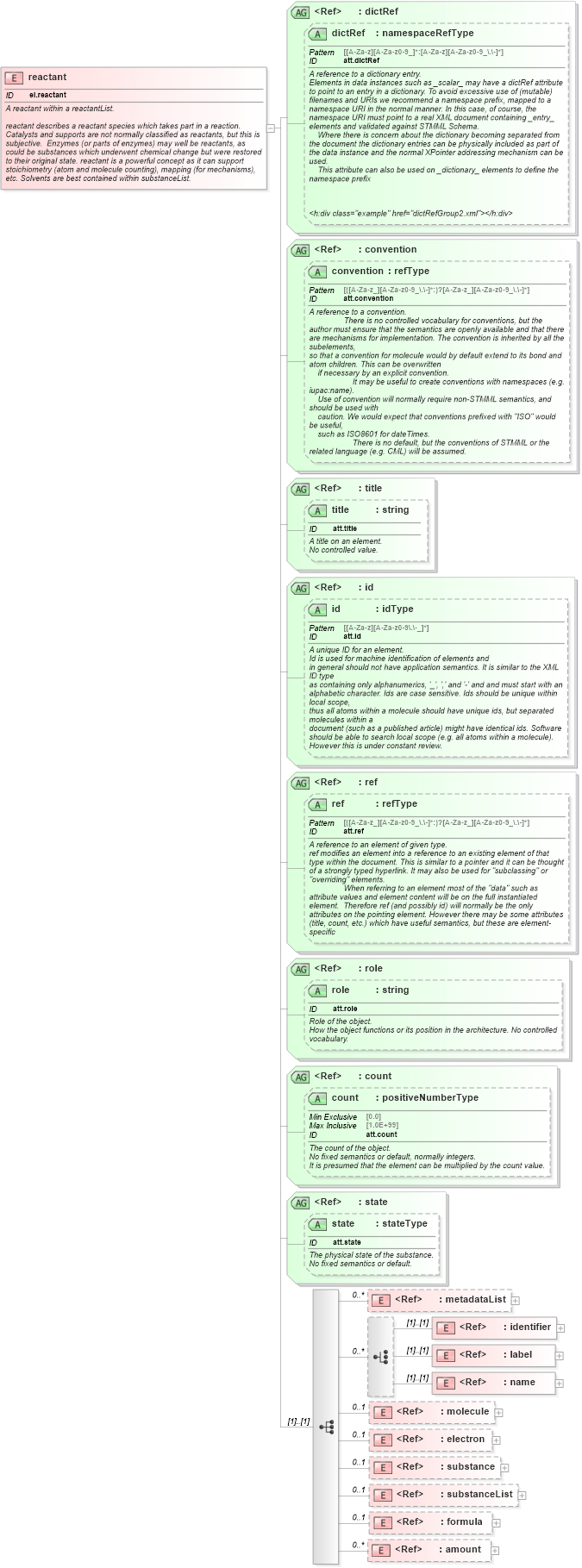
<xsd:element name="reactant" id="el.reactant">
    <xsd:annotation>
        <xsd:documentation>
            <h:div class="summary" xmlns:h="http://www.w3.org/1999/xhtml">A reactant within a reactantList.</h:div>
            <h:div class="description" xmlns:h="http://www.w3.org/1999/xhtml">
                <h:tt>reactant</h:tt> describes a reactant species which takes part in a reaction. Catalysts and supports are not normally classified as reactants, but this is subjective.  Enzymes (or parts of enzymes) may well be reactants, as could be substances which underwent chemical change but were restored to their original state. <h:tt>reactant</h:tt> is a powerful concept as it can support stoichiometry (atom and molecule counting), mapping (for mechanisms), etc. Solvents are best contained within substanceList.</h:div>
            <h:div class="example" href="reactant1.xml" xmlns:h="http://www.w3.org/1999/xhtml" />
        </xsd:documentation>
    </xsd:annotation>
    <xsd:complexType>
        <xsd:annotation>
            <xsd:documentation>
                <h:div xmlns:h="http://www.w3.org/1999/xhtml">A reactant will normally be identified by name(s), formula, or molecule and at least one of these should normally be given. Amount(s) of reactant can be given after this identification and can describe mass, volume, etc. but not stoichiometr.</h:div>
            </xsd:documentation>
        </xsd:annotation>
        <xsd:sequence>
            <xsd:element ref="metadataList" minOccurs="0" maxOccurs="unbounded" />
            <xsd:choice minOccurs="0" maxOccurs="unbounded">
                <xsd:element ref="identifier" />
                <xsd:element ref="label" />
                <xsd:element ref="name" />
            </xsd:choice>
            <xsd:element ref="molecule" minOccurs="0" maxOccurs="1" />
            <xsd:element ref="electron" minOccurs="0" maxOccurs="1" />
            <xsd:element ref="substance" minOccurs="0" maxOccurs="1" />
            <xsd:element ref="substanceList" minOccurs="0" maxOccurs="1" />
            <xsd:element ref="formula" minOccurs="0" maxOccurs="1" />
            <xsd:element ref="amount" minOccurs="0" maxOccurs="unbounded" />
        </xsd:sequence>
        <xsd:attributeGroup ref="dictRef" />
        <xsd:attributeGroup ref="convention" />
        <xsd:attributeGroup ref="title" />
        <xsd:attributeGroup ref="id" />
        <xsd:attributeGroup ref="ref" />
        <xsd:attributeGroup ref="role">
            <xsd:annotation>
                <xsd:documentation>
                    <h:div class="specific" xmlns:h="http://www.w3.org/1999/xhtml">The role of the reactant within a reactantList. Semantics are not yet controlled but could be limiting, oxidant, etc. TODO: a reactant might have multiple roles so this may have to become an element.</h:div>
                </xsd:documentation>
            </xsd:annotation>
        </xsd:attributeGroup>
        <xsd:attributeGroup ref="count">
            <xsd:annotation>
                <xsd:documentation>
                    <h:div class="specific" xmlns:h="http://www.w3.org/1999/xhtml">The number of copies of the reactant involved in the stoichiometric reaction. Could be non-integer but should not be used for actual ratios of materials added (for which amount should be used).</h:div>
                </xsd:documentation>
            </xsd:annotation>
        </xsd:attributeGroup>
        <xsd:attributeGroup ref="state" />
    </xsd:complexType>
</xsd:element>
|
 XSD Schema Diagram: