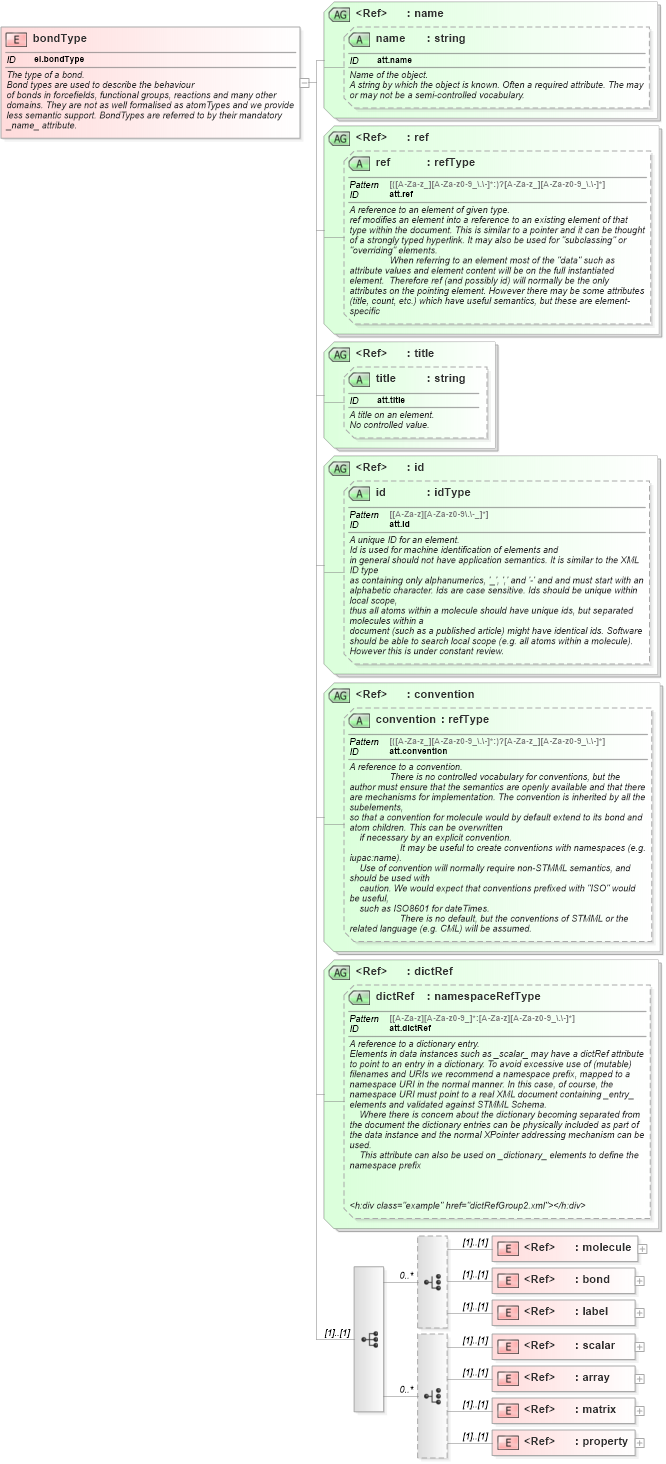
<xsd:element name="bondType" id="el.bondType">
    <xsd:annotation>
        <xsd:documentation>
            <h:div class="summary" xmlns:h="http://www.w3.org/1999/xhtml">The type of a bond.</h:div>
            <h:div class="description" xmlns:h="http://www.w3.org/1999/xhtml">Bond types are used to describe the behaviour
            of bonds in forcefields, functional groups, reactions and many other
            domains. They are not as well formalised as atomTypes and we provide
            less semantic support. BondTypes are referred to by their mandatory
            _name_ attribute.</h:div>
            <h:div class="example" href="bondType1.xml" xmlns:h="http://www.w3.org/1999/xhtml" />
        </xsd:documentation>
    </xsd:annotation>
    <xsd:complexType>
        <xsd:sequence>
            <xsd:choice minOccurs="0" maxOccurs="unbounded">
                <xsd:element ref="molecule" />
                <xsd:element ref="bond" />
                <xsd:element ref="label" />
            </xsd:choice>
            <xsd:choice minOccurs="0" maxOccurs="unbounded">
                <xsd:element ref="scalar" />
                <xsd:element ref="array" />
                <xsd:element ref="matrix" />
                <xsd:element ref="property" />
            </xsd:choice>
        </xsd:sequence>
        <xsd:attributeGroup ref="name">
            <xsd:annotation>
                <xsd:documentation>
                    <h:div class="specific" xmlns:h="http://www.w3.org/1999/xhtml">The bondType name. The name will usually be namespaced as 'gulp:si', 'tripos:c.3', etc. It must occur except when the ref attribute is given.</h:div>
                </xsd:documentation>
            </xsd:annotation>
        </xsd:attributeGroup>
        <xsd:attributeGroup ref="ref" />
        <xsd:attributeGroup ref="title" />
        <xsd:attributeGroup ref="id" />
        <xsd:attributeGroup ref="convention" />
        <xsd:attributeGroup ref="dictRef" />
    </xsd:complexType>
</xsd:element>
|
 XSD Schema Diagram: