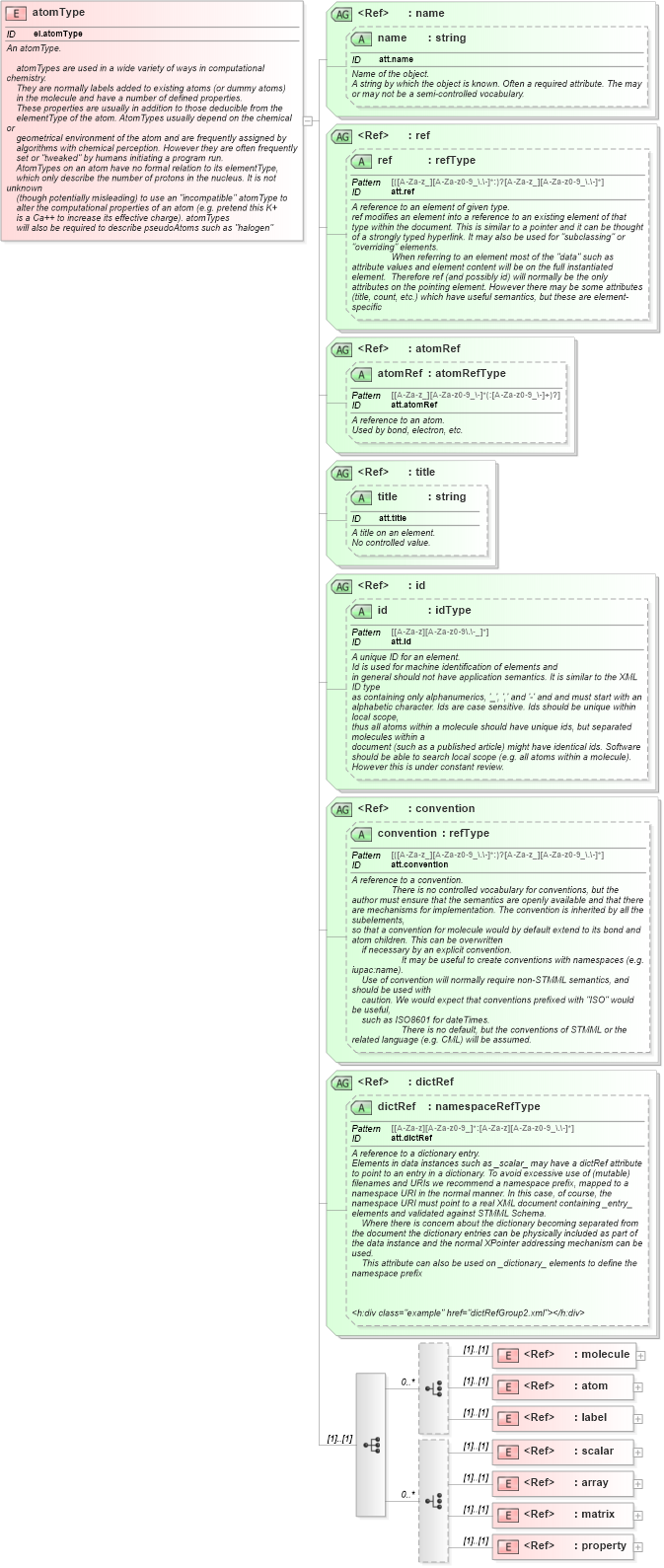
<xsd:element name="atomType" id="el.atomType">
    <xsd:annotation>
        <xsd:documentation>
            <h:div class="summary" xmlns:h="http://www.w3.org/1999/xhtml">An atomType.</h:div>
            <h:div class="description" xmlns:h="http://www.w3.org/1999/xhtml">
                <h:p>atomTypes are used in a wide variety of ways in computational chemistry.
                They are normally labels added to existing atoms (or dummy atoms)
                in the molecule and have a number of defined properties.
                These properties are usually in addition to those deducible from the
                elementType of the atom. AtomTypes usually depend on the chemical or
                geometrical environment of the atom and are frequently assigned by
                algorithms with chemical perception. However they are often frequently
                set or "tweaked" by humans initiating a program run.</h:p>
                <h:p>AtomTypes on an atom have no formal relation to its <h:tt>elementType</h:tt>,
                which only describe the number of protons in the nucleus. It is not unknown
                (though potentially misleading) to use an "incompatible" atomType to
                alter the computational properties of an atom (e.g. pretend this K+
                is a Ca++ to increase its effective charge). <h:tt>atomTypes</h:tt>
                will also be required to describe pseudoAtoms such as "halogen"
                (generic) or "methyl group" (unified atom). Atoms in computations
                can therefore have an <h:tt>atomType</h:tt> child with a "ref"
                attribute.</h:p>
                <h:p>An atomType contains numeric or other quantities associated with
                it (charges, masses, use in force-fields, etc.) and also description
                of any perception algorithms (chemical and/or geometrical) which could
                be used to compute or constrain it. This is still experimental.</h:p>
                <h:p>atomTypes are referred to by their mandatory <h:tt>name</h:tt>
                attribute. An atom refers to one or more atomTypes through
                atomType/@ref children</h:p>
            </h:div>
            <h:div class="example" href="atomType1.xml" xmlns:h="http://www.w3.org/1999/xhtml" />
            <h:div class="note" xmlns:h="http://www.w3.org/1999/xhtml">examples not yet teste.</h:div>
        </xsd:documentation>
    </xsd:annotation>
    <xsd:complexType>
        <xsd:sequence>
            <xsd:choice minOccurs="0" maxOccurs="unbounded">
                <xsd:element ref="molecule" />
                <xsd:element ref="atom" />
                <xsd:element ref="label" />
            </xsd:choice>
            <xsd:choice minOccurs="0" maxOccurs="unbounded">
                <xsd:element ref="scalar" />
                <xsd:element ref="array" />
                <xsd:element ref="matrix" />
                <xsd:element ref="property" />
            </xsd:choice>
        </xsd:sequence>
        <xsd:attributeGroup ref="name">
            <xsd:annotation>
                <xsd:documentation>
                    <h:div class="specific" xmlns:h="http://www.w3.org/1999/xhtml">The name will usually be namespaced as 'gulp:si', 'tripos:c.3', etc. It must occur except for atomType/@re.</h:div>
                </xsd:documentation>
            </xsd:annotation>
        </xsd:attributeGroup>
        <xsd:attributeGroup ref="ref" />
        <!-- what do we need this for? -->
        <xsd:attributeGroup ref="atomRef" />
        <xsd:attributeGroup ref="title" />
        <xsd:attributeGroup ref="id" />
        <xsd:attributeGroup ref="convention" />
        <xsd:attributeGroup ref="dictRef" />
    </xsd:complexType>
</xsd:element>
|
 XSD Schema Diagram: