Definition Type: Element
Name: atom
Namespace: http://www.xml-cml.org/schema
Containing Schema: schema.xsd
Abstract
Documentation:
An atom. Atoms can only be chosen from the periodic table and superatoms such as "Phe" or "Tyr" are not allowed. The elementType of an atom is identified by that attribute. There are two additional elementTypes, "Du" (for an object which does not have an identifiable nucleus but is useful in calculations and definitions (such as a centroid); and "R" which describes a generic fragment. Although atoms have an elementType, they do not, by default, support arbitrary atomTypes for which the <atomType> element should be used. 2006-01-12: PMR. Added vector3 child to support accelerations, velocities, dipole, etc. 2006-06-01: PMR. Added documentation.
Collapse XSD Schema Diagram:
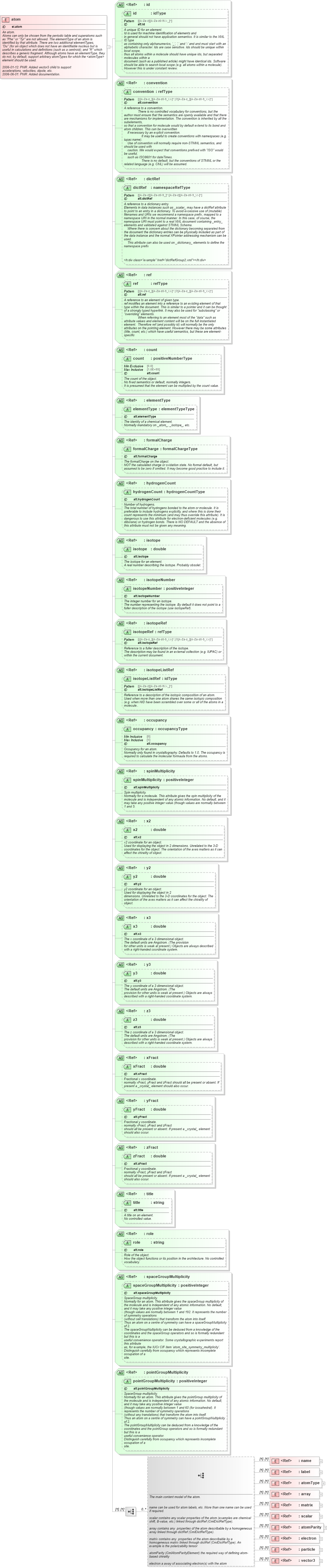
Drilldown into vector3 in schema schema_xsd Drilldown into particle in schema schema_xsd Drilldown into electron in schema schema_xsd Drilldown into atomParity in schema schema_xsd Drilldown into scalar in schema schema_xsd Drilldown into matrix in schema schema_xsd Drilldown into array in schema schema_xsd Drilldown into atomType in schema schema_xsd Drilldown into label in schema schema_xsd Drilldown into name in schema schema_xsd Drilldown into pointGroupMultiplicity in schema schema_xsd Drilldown into pointGroupMultiplicity in schema schema_xsd Drilldown into spaceGroupMultiplicity in schema schema_xsd Drilldown into spaceGroupMultiplicity in schema schema_xsd Drilldown into role in schema schema_xsd Drilldown into role in schema schema_xsd Drilldown into title in schema schema_xsd Drilldown into title in schema schema_xsd Drilldown into zFract in schema schema_xsd Drilldown into zFract in schema schema_xsd Drilldown into yFract in schema schema_xsd Drilldown into yFract in schema schema_xsd Drilldown into xFract in schema schema_xsd Drilldown into xFract in schema schema_xsd Drilldown into z3 in schema schema_xsd Drilldown into z3 in schema schema_xsd Drilldown into y3 in schema schema_xsd Drilldown into y3 in schema schema_xsd Drilldown into x3 in schema schema_xsd Drilldown into x3 in schema schema_xsd Drilldown into y2 in schema schema_xsd Drilldown into y2 in schema schema_xsd Drilldown into x2 in schema schema_xsd Drilldown into x2 in schema schema_xsd Drilldown into spinMultiplicity in schema schema_xsd Drilldown into spinMultiplicity in schema schema_xsd Drilldown into occupancy in schema schema_xsd Drilldown into occupancy in schema schema_xsd Drilldown into isotopeListRef in schema schema_xsd Drilldown into isotopeListRef in schema schema_xsd Drilldown into isotopeRef in schema schema_xsd Drilldown into isotopeRef in schema schema_xsd Drilldown into isotopeNumber in schema schema_xsd Drilldown into isotopeNumber in schema schema_xsd Drilldown into isotope in schema schema_xsd Drilldown into isotope in schema schema_xsd Drilldown into hydrogenCount in schema schema_xsd Drilldown into hydrogenCount in schema schema_xsd Drilldown into formalCharge in schema schema_xsd Drilldown into formalCharge in schema schema_xsd Drilldown into elementType in schema schema_xsd Drilldown into elementType in schema schema_xsd Drilldown into count in schema schema_xsd Drilldown into count in schema schema_xsd Drilldown into ref in schema schema_xsd Drilldown into ref in schema schema_xsd Drilldown into dictRef in schema schema_xsd Drilldown into dictRef in schema schema_xsd Drilldown into convention in schema schema_xsd Drilldown into convention in schema schema_xsd Drilldown into id in schema schema_xsd Drilldown into id in schema schema_xsdXSD Diagram of atom in schema schema_xsd (Chemical Markup Language (CML))
Collapse XSD Schema Code:
<xsd:element name="atom" id="el.atom">
    <xsd:annotation>
        <xsd:documentation>
            <h:div class="summary" xmlns:h="http://www.w3.org/1999/xhtml">An atom.</h:div>
            <h:div documentation="general" xmlns:h="http://www.w3.org/1999/xhtml">Atoms can only be chosen from the periodic table and superatoms such as "Phe" or "Tyr" are not allowed. The elementType of an atom is identified by that attribute. There are two additional elementTypes, "Du" (for an object which does not have an identifiable nucleus but is useful in calculations and definitions (such as a centroid); and "R" which describes a generic fragment. Although atoms have an elementType, they do not, by default, support arbitrary atomTypes for which the &lt;atomType&gt; element should be used.</h:div>
            <h:div class="example" href="atom1.xml" xmlns:h="http://www.w3.org/1999/xhtml" />
            <h:div class="curation" xmlns:h="http://www.w3.org/1999/xhtml">2006-01-12: PMR. Added vector3 child to support
            accelerations, velocities, dipole, etc.</h:div>
            <h:div class="curation" xmlns:h="http://www.w3.org/1999/xhtml">2006-06-01: PMR. Added documentation.</h:div>
        </xsd:documentation>
        <xsd:appinfo />
    </xsd:annotation>
    <xsd:complexType>
        <xsd:choice>
            <xsd:choice minOccurs="0" maxOccurs="unbounded">
                <xsd:annotation>
                    <xsd:documentation>
                        <h:div class="general" xmlns:h="http://www.w3.org/1999/xhtml">
                            <h:p>The main content model of the atom.</h:p>
                            <h:ul>
                                <h:li>
                                    <h:b>name</h:b> can be used for atom labels, etc. More than one name can be used if required.</h:li>
                                <h:li>
                                    <h:b>scalar</h:b> contains any scalar properties of the atom (examples are chemical shift, B-value, etc.) linked through <h:tt>dictRef</h:tt> (CmlDictRefType).</h:li>
                                <h:li>
                                    <h:b>array</h:b> contains any  properties of the atom describable by a homogeneous array linked through <h:tt>dictRef</h:tt> (CmlDictRefType).</h:li>
                                <h:li>
                                    <h:b>matrix</h:b> contains any  properties of the atom describable by a homogeneous matrix linked through <h:tt>dictRef</h:tt> (CmlDictRefType). An example is the polarizability tensor</h:li>
                                <h:li>
                                    <h:b>atomParity</h:b> (CmlAtomParityElement) the required way of defining atom-based chirality</h:li>
                                <h:li>
                                    <h:b>electron</h:b> a away of associating electron(s) with the atom</h:li>
                            </h:ul>
                        </h:div>
                    </xsd:documentation>
                </xsd:annotation>
                <xsd:element ref="name" />
                <xsd:element ref="label" />
                <xsd:element ref="atomType" />
                <xsd:element ref="array" />
                <xsd:element ref="matrix" />
                <xsd:element ref="scalar" />
                <xsd:element ref="atomParity" />
                <xsd:element ref="electron" />
                <xsd:element ref="particle" />
                <xsd:element ref="vector3" />
            </xsd:choice>
        </xsd:choice>
        <xsd:attributeGroup ref="id" />
        <xsd:attributeGroup ref="convention" />
        <xsd:attributeGroup ref="dictRef" />
        <xsd:attributeGroup ref="ref" />
        <xsd:attributeGroup ref="count">
            <xsd:annotation>
                <xsd:documentation>
                    <h:div class="specific" xmlns:h="http://www.w3.org/1999/xhtml">Most useful in _formula_ but possibly useful in _atomArray_ where coordinates and connectivity is not defined. No formal default, but assumed to be 1.</h:div>
                </xsd:documentation>
            </xsd:annotation>
        </xsd:attributeGroup>
        <xsd:attributeGroup ref="elementType" />
        <xsd:attributeGroup ref="formalCharge" />
        <xsd:attributeGroup ref="hydrogenCount" />
        <xsd:attributeGroup ref="isotope" />
        <xsd:attributeGroup ref="isotopeNumber" />
        <xsd:attributeGroup ref="isotopeRef" />
        <xsd:attributeGroup ref="isotopeListRef" />
        <xsd:attributeGroup ref="occupancy" />
        <xsd:attributeGroup ref="spinMultiplicity" />
        <xsd:attributeGroup ref="x2" />
        <xsd:attributeGroup ref="y2" />
        <xsd:attributeGroup ref="x3" />
        <xsd:attributeGroup ref="y3" />
        <xsd:attributeGroup ref="z3" />
        <xsd:attributeGroup ref="xFract" />
        <xsd:attributeGroup ref="yFract" />
        <xsd:attributeGroup ref="zFract" />
        <xsd:attributeGroup ref="title" />
        <xsd:attributeGroup ref="role">
            <xsd:annotation>
                <xsd:documentation>
                    <h:div class="specific" xmlns:h="http://www.w3.org/1999/xhtml">This can be used to describe the purpose of atoms whose _elementType_s are __dummy__ or __locant__. Vocabulary not controlled.</h:div>
                </xsd:documentation>
            </xsd:annotation>
        </xsd:attributeGroup>
        <xsd:attributeGroup ref="spaceGroupMultiplicity">
            <xsd:annotation>
                <xsd:documentation>
                    <h:div class="curation" xmlns:h="http://www.w3.org/1999/xhtml">2005-11-27: Added PMR </h:div>
                </xsd:documentation>
            </xsd:annotation>
        </xsd:attributeGroup>
        <xsd:attributeGroup ref="pointGroupMultiplicity">
            <xsd:annotation>
                <xsd:documentation>
                    <h:div class="curation" xmlns:h="http://www.w3.org/1999/xhtml">2005-11-27: Added PMR </h:div>
                </xsd:documentation>
            </xsd:annotation>
        </xsd:attributeGroup>
    </xsd:complexType>
</xsd:element>
Collapse Child Elements:
Name Type Min Occurs Max Occurs
name nsA:name (1) (1)
label nsA:label (1) (1)
atomType nsA:atomType (1) (1)
array nsA:array (1) (1)
matrix nsA:matrix (1) (1)
scalar nsA:scalar (1) (1)
atomParity nsA:atomParity (1) (1)
electron nsA:electron (1) (1)
particle nsA:particle (1) (1)
vector3 nsA:vector3 (1) (1)
Collapse Child Attributes:
Name Type Default Value Use
id nsA:id (Optional)
convention nsA:convention (Optional)
dictRef nsA:dictRef (Optional)
ref nsA:ref (Optional)
count nsA:count (Optional)
elementType nsA:elementType (Optional)
formalCharge nsA:formalCharge (Optional)
hydrogenCount nsA:hydrogenCount (Optional)
isotope nsA:isotope (Optional)
isotopeNumber nsA:isotopeNumber (Optional)
isotopeRef nsA:isotopeRef (Optional)
isotopeListRef nsA:isotopeListRef (Optional)
occupancy nsA:occupancy (Optional)
spinMultiplicity nsA:spinMultiplicity (Optional)
x2 nsA:x2 (Optional)
y2 nsA:y2 (Optional)
x3 nsA:x3 (Optional)
y3 nsA:y3 (Optional)
z3 nsA:z3 (Optional)
xFract nsA:xFract (Optional)
yFract nsA:yFract (Optional)
zFract nsA:zFract (Optional)
title nsA:title (Optional)
role nsA:role (Optional)
spaceGroupMultiplicity nsA:spaceGroupMultiplicity (Optional)
pointGroupMultiplicity nsA:pointGroupMultiplicity (Optional)